
Read, reflect, pray
Sutta Nipāta 2-8: Nāvāsutta
Viggo Fausböll, 1881 · Historical English translation
1. A man should worship him from whom he learns the Dhamma, as the gods (worship) Inda; the learned man being worshipped and pleased with him, makes the (highest) Dhamma manifest. (315)
2. Having heard and considered that (Dhamma), the wise man practising the Dhamma that is in accordance with the (highest) Dhamma, becomes learned, expert, and skilful, strenuously associating with such a (learned teacher). (316)
3. He who serves a low (teacher), a fool who has not understood the meaning, and who is envious, goes to death, not having overcome doubt, and not having understood the Dhamma. (317)
4. As a man, after descending into a river, a turgid water with a rapid current, is borne along following the current,—how will he be able to put others across? (318)
5. Even so how will a man, not having understood the Dhamma, and not attending to the explanation of the learned and not knowing it himself, not having overcome doubt, be able to make others understand it? (319)
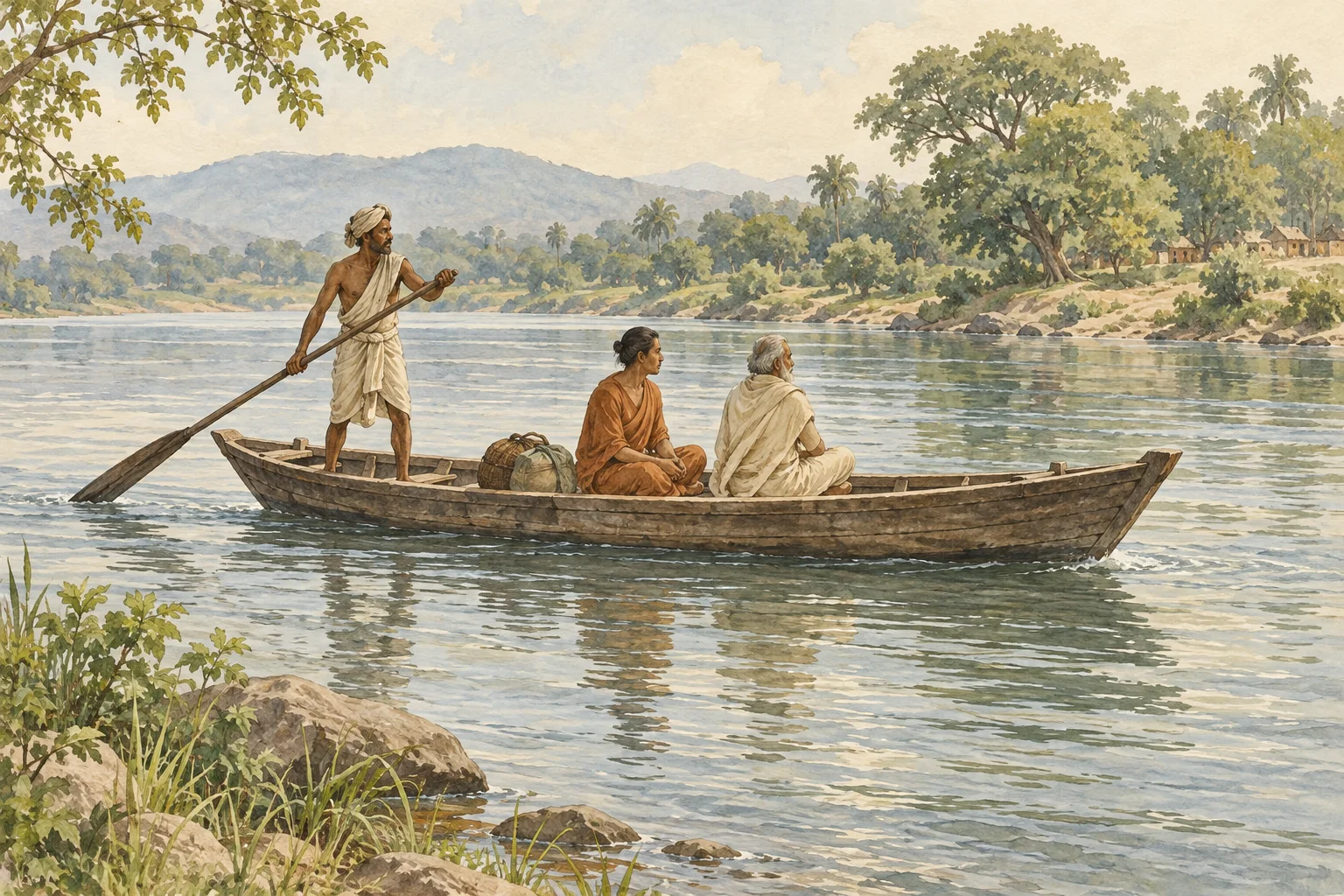
6. As one, having gone on board a strong ship, provided with oars and rudder, carries across in it many others, knowing the way to do it, and being expert and thoughtful, (320)
7. So also he who is accomplished, of a cultivated mind, learned, intrepid, makes others endowed with attention and assiduity understand it, knowing (it himself). (321)
8. Therefore indeed one should cultivate (the society of) a good man, who is intelligent and learned; he who leads a regular life, having understood what is good and penetrated the Dhamma, will obtain happiness. (322)
Nāvāsutta is ended.
Translation, numbering and rights
Viggo Fausböll, 1881. Public-domain 1881 translation, from the free non-commercial EPUB distributed by Reading Faithfully (edition 1.0, February 2012), transcribed by Christopher M. Weimer for the Internet Sacred Text Archive. This reader is free and non-commercial. Pali diacritics follow the EPUB. Translator introductions and footnotes are omitted; discourse prose, verses and the concluding passages are retained.
This 1881 edition uses consecutive verse numbers ending at 1148. It differs from the Japanese edition and must not be aligned by verse number alone. The final reading includes the concluding praises and Piṅgiya’s dialogue. The source’s printed numbering is retained, including gaps. A repeated “1041” in the source is retained; the expected “1047” is not silently substituted. No verse text is supplied by guesswork.
This historical English translation uses older vocabulary. It is independent of the Japanese translation linked from this site. The Japanese edition’s translator and license are credited there.