
Bodhisattva (bosatsu)
Kongōge
金剛牙
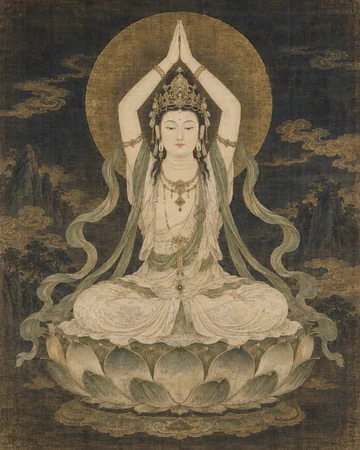
Expresses the stern work of subduing what hinders awakening. One of the Sixteen Great Bodhisattvas of the Diamond Realm.
This introduction is based on materials from Shōhōin (Tobi Fudō). It is summarized within the scope of the beliefs and traditions those materials convey, and does not present explanations or customs common to all schools, shrines, and temples.
English pages are the site’s own translations of its Japanese pages. The sources cited are in Japanese. 日本語で読む
The work this bodhisattva expresses
Expresses the stern work of subduing what hinders awakening.
Source: 真言宗単立本山 威徳山金剛寺
The name and role of Kongōge
One of the Sixteen Great Bodhisattvas, also called Chōbuku Kongō Bosatsu. It is listed as a bodhisattva positioned in the north of the four directions of the Diamond Realm and belonging to Fukūjōju Nyorai.
Source: 飛不動尊 正宝院・飛不動尊 正宝院・飛不動尊 正宝院
Tracing the form and the traditions
It is explained as an extremely rare form with the hands joined above the head.
Source: 飛不動尊 正宝院・飛不動尊 正宝院・飛不動尊 正宝院
Bodhisattvas attending the four buddhas of the Diamond Realm
The Sixteen Great Bodhisattvas are bodhisattvas assigned four each to the four buddhas of the Diamond Realm: Ashuku, Hōshō, Amida (Muryōju) and Fukūjōju. In the mandala centered on Dainichi Nyorai and the four buddhas, they express the wisdom and workings of the buddhas through their individual names and forms. They are deities to be understood through their relation to the mandala as a whole, rather than as single deities each in charge of a particular area.
Source: 飛不動尊 正宝院・関西大学
Reading the objects held and the position in the mandala
Objects held, such as a vajra, a jewel, a bow, a flower and a sutra scroll, are clues that show each deity's work. The individual pages introduce the meanings given in Shōhōin's iconographic notes. These sixteen deities belonging to the Diamond Realm Mandala and groups such as the Twenty-Five Bodhisattvas, who represent the welcome into the Pure Land, belong to different bodies of teaching.
Source: 飛不動尊 正宝院・飛不動尊 正宝院
About how the name is written
Shōhōin's individual page writes the name as "金剛芽", and its list of the Sixteen Great Bodhisattvas as "金剛牙". Checking also against "金剛牙菩薩" in a Japanese translation of the Kongōchō Kyō, this page writes it as "金剛牙". In the same Japanese translation, "yakisha" in the heart mantra is explained as "O 金剛薬叉 (Kongō Yasha)". This is a passage calling one of the Sixteen Great Bodhisattvas, and it is distinguished from Kongō Yasha Myōō as a myōō.
Source: 飛不動尊 正宝院・飛不動尊 正宝院・真言宗豊山派 総合研究院
Mantra (in Japanese, as written in the sources)
バザラ ヤキシャ
Source: 真言宗豊山派 総合研究院
Shown as written in the Japanese sources. This site does not set how or how many times to recite it.
Related kami and buddhas
Sources (in Japanese)
- 飛不動尊 正宝院「仏様の世界:金剛芽」(2026-10-14 確認)
- 飛不動尊 正宝院「仏様の世界:目次」(2026-10-14 確認)
- 飛不動尊 正宝院「仏様の世界:十六大菩薩」(2026-10-14 確認)
- 関西大学「地域計画特論(11)曼荼羅の世界観」(2026-10-14 確認)
- 飛不動尊 正宝院「仏様の世界:二十五菩薩」(2026-10-14 確認)
- 真言宗豊山派 総合研究院「髙橋尚夫「『金剛頂経』和訳(三)」『豊山学報』第62号」(2026-10-16 確認)
- 真言宗単立本山 威徳山金剛寺「金剛頂経を読み解く」(2026-10-16 確認)