
Deva (ten) or guardian deity
Nanda Ryūō
難陀龍王
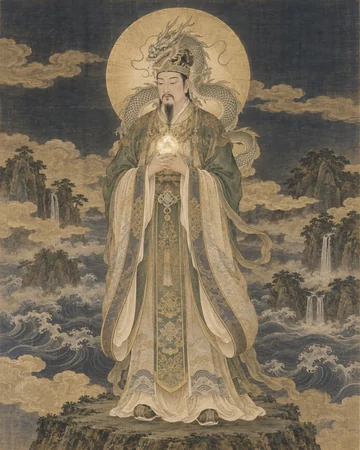
A dragon king listed as one of the Twenty-Eight Attendants and described as the foremost of the Eight Great Dragon Kings. The Twenty-Eight Attendants are a group that protects the Thousand-Armed Kannon and the people who have faith in its teachings.
This introduction is based on materials published by shrines, temples, and schools, starting with Shōhōin. It is summarized within the scope of the beliefs and traditions those materials convey, and does not present explanations or customs common to all schools, shrines, and temples.
English pages are the site’s own translations of its Japanese pages. The sources cited are in Japanese. 日本語で読む
The name and role of Nanda Ryūō
A dragon king listed as one of the Twenty-Eight Attendants and described as the foremost of the Eight Great Dragon Kings.
Source: 飛不動尊 正宝院・飛不動尊 正宝院・飛不動尊 正宝院
Tracing its form and traditions
It is said to hold a jewel in both hands. The text lists eight names as the Eight Great Dragon Kings: Nanda, Batsunanda, Shakara, Washukitsu, Tokushaka, Anabadatta, Manashi and Uhatsura.
Source: 飛不動尊 正宝院・飛不動尊 正宝院・飛不動尊 正宝院
A guardian group supporting the salvation of the Thousand-Armed Kannon
The Twenty-Eight Attendants are deities who protect the Thousand-Armed Kannon and the people who have faith in its teachings. The Four Heavenly Kings, gods with origins in India and others form a group as protectors of Buddhism. At Sanjūsangendō they are described as attendants and companions of the Thousand-Armed Kannon.
Source: 飛不動尊 正宝院・蓮華王院 三十三間堂
Names and forms differ by scripture
The makeup of the Twenty-Eight Attendants and the forms of their images differ depending on the scriptural account. Because deities of the same name also appear in other groups of guardian deities, here we introduce separately "their role as members of the Twenty-Eight Attendants" and the character handed down for each individually. We do not treat the statues of Sanjūsangendō and Shōhōin's iconographic materials as having the same arrangement or forms.
Source: 蓮華王院 三十三間堂・飛不動尊 正宝院
As a dragon king who governs the sea
Kiyomizu-dera introduces Nanda Ryūō of the Twenty-Eight Attendants as governing the oceans. Its character as a protector connected with the sea overlaps with the group's role of protecting those who have faith in the Thousand-Armed Kannon.
Source: 音羽山 清水寺
Protecting from calamity those who have faith in Kannon
Kiyomizu-dera explains the role of the Twenty-Eight Attendants as protecting from calamity those who keep the Thousand-Armed Kannon in mind and call its name. Deities connected with various realms, such as the sea and the land, together support Kannon's work of salvation. This is a belief shared by the Twenty-Eight Attendants as a whole, and it does not assign the fulfillment of a separate wish to each deity.
Source: 音羽山 清水寺
Mantra (in Japanese, as written in the sources)
南麼三曼多勃馱喃 難徒鉢難捺瑜 娑訶
Source: CBETA 電子佛典(大正新脩大藏經 第18冊 No.848)
Shown as written in the Japanese sources. This site does not set how or how many times to recite it.
Related kami and buddhas
Sources (in Japanese)
- 飛不動尊 正宝院「仏様の世界:難陀龍王」(2026-10-14 確認)
- 飛不動尊 正宝院「仏様の世界:目次」(2026-10-14 確認)
- 飛不動尊 正宝院「仏様の世界:二十八部衆」(2026-10-14 確認)
- 蓮華王院 三十三間堂「二十八部衆像」(2026-10-15 確認)
- 音羽山 清水寺「眷属 二十八部衆」(2026-10-17 確認)
- CBETA 電子佛典(大正新脩大藏經 第18冊 No.848)「大毘盧遮那成佛神變加持經(大日経)巻第二 普通真言藏品」(2026-10-22 確認)