
Bodhisattva (bosatsu)
Muryōrikiku
无量力吼
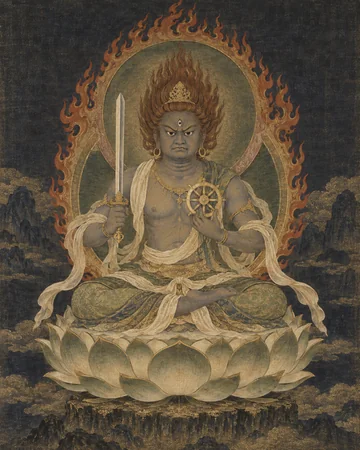
Introduced as one of the Five Great Strength Bodhisattvas (Godairiki Bosatsu).
This introduction is based on materials from Shōhōin (Tobi Fudō). It is summarized within the scope of the beliefs and traditions those materials convey, and does not present explanations or customs common to all schools, shrines, and temples.
English pages are the site’s own translations of its Japanese pages. The sources cited are in Japanese. 日本語で読む
The name and role of Muryōrikiku
Introduced as one of the Five Great Strength Bodhisattvas. It is also written 無量力吼; in the new translation its direction is said to be the center, and it is said to correspond to Kongō Haramitta Bosatsu.
Source: 飛不動尊 正宝院・飛不動尊 正宝院・飛不動尊 正宝院
Tracing the form and traditions
It is said to have three eyes and to hold a wheel of five thousand swords in the right hand and a Dharma wheel in the left.
Source: 飛不動尊 正宝院・飛不動尊 正宝院・飛不動尊 正宝院
Five powers prayed to for the protection of the land
The Five Great Strength Bodhisattvas are taught in the Ninnō Hannya Kyō as deities who protect a country that upholds Buddhism, and they became the principal objects of worship at the Ninnō-e, a ceremony praying for the protection of the nation. Though they are bodhisattvas, they are characteristically depicted with wrathful expressions like myōō. They are also called the Godairikison or the Gohō Bosatsu.
Source: 飛不動尊 正宝院
Differences arising from sutra translations and later devotion
Shōhōin explains that the settings of each bodhisattva differ between the old and new translations of the Ninnō Hannya Kyō. They were later linked with the Five Great Myōō, but the names and positions of the Five Great Strength Bodhisattvas and the Five Great Myōō cannot simply be substituted for each other. The description of each deity can be read as an explanation of the lineage that Shōhōin presents.
Source: 飛不動尊 正宝院
Related kami and buddhas
Sources (in Japanese)
- 飛不動尊 正宝院「仏様の世界:无量力吼」(2026-10-14 確認)
- 飛不動尊 正宝院「仏様の世界:目次」(2026-10-14 確認)
- 飛不動尊 正宝院「仏様の世界:五大力菩薩」(2026-10-14 確認)
- 鹿鳴文庫「仏像図彙:五大力菩薩」(2026-10-15 確認)