
Kami of the Kojiki
Yamata no Orochi
八俣遠呂智
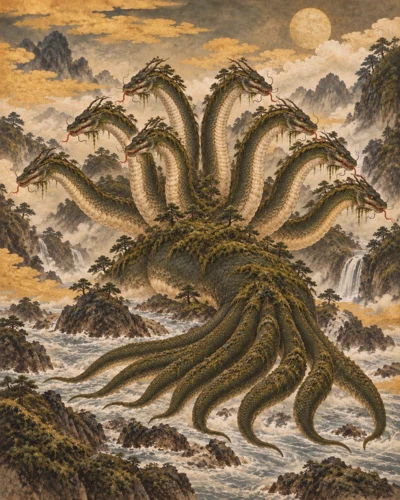
Upstream on the Hi River in Izumo, it was the Yamata no Orochi of Koshi that came every year seeking Kushinadahime, the daughter of Ashinazuchi and Tenazuchi. Its eyes were red, it had eight heads and tails, and it was large enough to stretch across valleys and mountains. Susanoo no Mikoto prepared yashiori sake, made it drunk, and overcame it with his sword. A great sword found in its tail was presented to Amaterasu Ōmikami as Kusanagi no Tachi.
This page introduces the name and the story recorded in the Kojiki.
English pages are the site’s own translations of its Japanese pages. The sources cited are in Japanese. 日本語で読む
Story and genealogy in the Kojiki
Upstream on the Hi River in Izumo, it was the Yamata no Orochi of Koshi that came every year seeking Kushinadahime, the daughter of Ashinazuchi and Tenazuchi. Its eyes were red, it had eight heads and tails, and it was large enough to stretch across valleys and mountains. Susanoo no Mikoto prepared yashiori sake, made it drunk, and overcame it with his sword. A great sword found in its tail was presented to Amaterasu Ōmikami as Kusanagi no Tachi.
Source: 國學院大學・國學院大學
Names and how they are recorded
Also called Koshi no Yamata no Orochi.
Source: 國學院大學
Scenes in the text
Appears in the Kojiki in “The Slaying of the Eight-Forked Serpent” (first volume). You can trace the relevant passages of the text through the sources below.
Source: 國學院大學・國學院大學
A great serpent with eight heads and tails
The Kojiki describes it as a great serpent with eight heads and eight tails on a single body, red eyes, and moss and trees growing on its body. In this illustration the heads and tails are spread out so that they can be counted. Its size, straddling mountains and valleys, is an expression of the myth, not a record of a real animal.
Source: 國學院大學・青空文庫/武田祐吉校訂
An example of a chant (in Japanese)
祓え給い、清め給え、神(かむ)ながら守り給い、幸(さきわ)え給え
Sources (in Japanese)
- 國學院大學「古事記ビューアー・神名データベース「八俣遠呂智」」(2026-10-15 確認)
- 國學院大學「古事記ビューアー 八俣の大蛇退治②」(2026-10-15 確認)
- 青空文庫/武田祐吉校訂「校註 古事記 〔八俣の大蛇〕」(2026-10-15 確認)