
Deva (ten) or guardian deity
Mekira Taishō
迷企羅大将
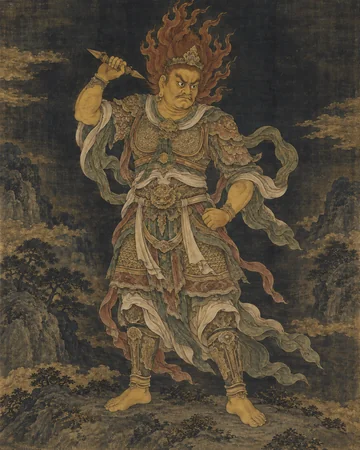
Listed as one of the group of Yakushi's Twelve Heavenly Generals (Jūni Shinshō). The Twelve Heavenly Generals are twelve generals who protect Yakushi Nyorai and the people who believe in his teaching.
This introduction is based on materials from Shōhōin (Tobi Fudō). It is summarized within the scope of the beliefs and traditions those materials convey, and does not present explanations or customs common to all schools, shrines, and temples.
English pages are the site’s own translations of its Japanese pages. The sources cited are in Japanese. 日本語で読む
The name and role of Mekira Taishō
Listed as one of the group of Yakushi's Twelve Heavenly Generals. It is assigned to the Rooster among the twelve zodiac animals, and its honji-butsu is said to be Amida Nyorai. "弥法羅 (Mikora)" is given as a commonly used alternative name.
Source: 飛不動尊 正宝院・飛不動尊 正宝院・飛不動尊 正宝院
Tracing the form and traditions
Its attribute is said to be a single-pronged ritual implement (tokko) and its body color yellow. A note explains that the character 法 in the alternative name is a substitute used because of font limitations, and that the original is a character with the "person" radical.
Source: 飛不動尊 正宝院・飛不動尊 正宝院・飛不動尊 正宝院
Protecting Yakushi Nyorai and those who believe in his teaching
The Twelve Heavenly Generals are twelve generals who protect Yakushi Nyorai's world and its believers. Shin-Yakushi-ji explains that each leads a retinue of seven thousand. Their fearsome faces and weapons are handed down not as a means of threatening people but as forms showing the strong work of protecting the Buddhist teaching.
Source: 新薬師寺
The peace prayed for in Yakushi devotion
In Yakushi devotion, in which people pray for relief from illness and misfortune, the Twelve Heavenly Generals carry out its protection. There is also devotion linking them with the twelve zodiac animals, but the deity names and the assignment of zodiac animals differ by source and temple. The individual assignments and attributes on this page are one example from the Butsuzō Zui lineage introduced by Shōhōin, not a correspondence table common to all temples.
Source: 新薬師寺・飛不動尊 正宝院・奈良薬師寺
Mantra (in Japanese, as written in the sources)
おん めきら そわか。
Source: 飛不動尊 正宝院
Shown as written in the Japanese sources. This site does not set how or how many times to recite it.
Related kami and buddhas
Sources (in Japanese)
- 飛不動尊 正宝院「仏様の世界:迷企羅大将」(2026-10-14 確認)
- 飛不動尊 正宝院「仏様の世界:目次」(2026-10-14 確認)
- 飛不動尊 正宝院「仏様の世界:薬師十二神将」(2026-10-14 確認)
- 新薬師寺「十二神将」(2026-10-15 確認)
- 奈良薬師寺「金堂」(2026-10-14 確認)
- 国立台湾大学図書館/CBETA「薬師琉璃光如来本願功徳経(玄奘訳・大正蔵 T0450)」(2026-10-16 確認)