
Buddha (nyorai)
Amida Nyorai
阿弥陀如来
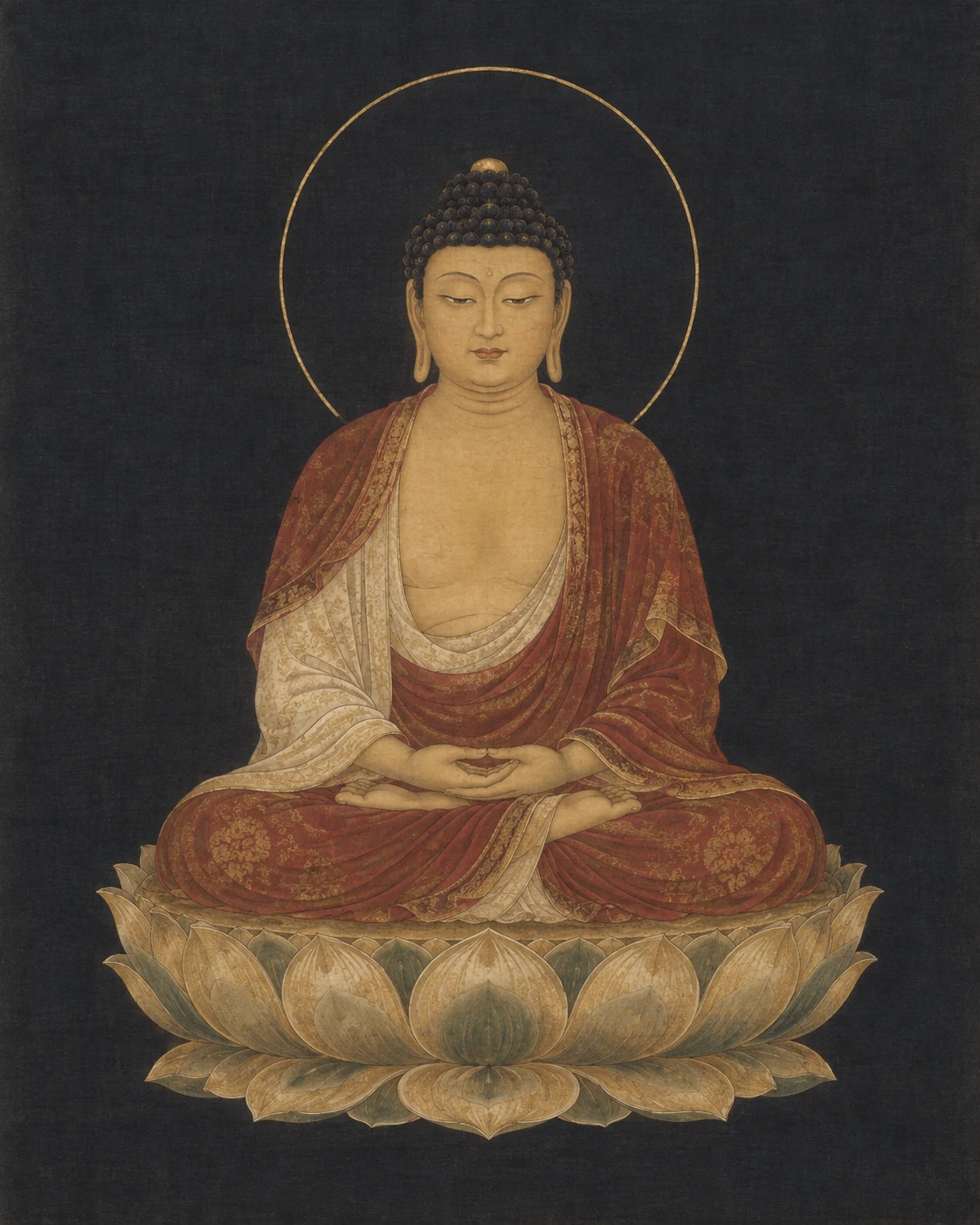
Amida Nyorai is taught as the buddha of the Western Pure Land of Utmost Bliss (Gokuraku Jōdo). His two names, Muryōkō and Muryōju, express immeasurable light and immeasurable life. He is the central buddha of the various Pure Land schools, and is also depicted as the Amida Triad, accompanied by the two bodhisattvas Kannon and Seishi.
This introduction is based on materials from Shōhōin (Tobi Fudō). It is summarized within the scope of the beliefs and traditions those materials convey, and does not present explanations or practices shared by all schools, temples, and shrines.
English pages are the site’s own translations of its Japanese pages. The sources cited are in Japanese. 日本語で読む
A buddha whose names mean boundless light and life
Amida Nyorai is taught as the buddha of the Western Pure Land of Utmost Bliss (Gokuraku Jōdo). His two names, Muryōkō and Muryōju, express immeasurable light and immeasurable life. He is the central buddha of the various Pure Land schools, and is also depicted as the Amida Triad, accompanied by the two bodhisattvas Kannon and Seishi.
Source: 浄土宗
The vow to lead people to the Pure Land
At the heart of faith in Amida is the Original Vow (hongan): not to abandon people in the midst of suffering, but to lead them to the Pure Land. The Jōdo school values the nenbutsu, calling on Amida Buddha, and rebirth in the Pure Land (ōjō). Each school has its own teachings on how rebirth and salvation are understood and on the place of the words that are recited.
Source: 浄土宗・浄土宗
The forty-eight vows made by Hōzō Bosatsu
In the story told in the sutras, Hōzō Bosatsu, in the presence of Sejizaiō Nyorai, aspires to become a buddha who saves people. It is taught that he fulfilled the forty-eight vows he made for this purpose and became Amida Buddha. The long reflection and practice before he became a buddha are also a story expressing his care for people who seek salvation.
Source: 浄土宗
Hands of welcome, hands of meditation
There are many kinds of statues of Amida Nyorai, including forms representing his coming to welcome the dying (raigō) and seated forms forming a mudra. The image published by Shōhōin is explained as showing the jōbon jōshō mudra, and among the Five Buddhas of the Diamond Realm (Kongōkai) he is placed in the west. Even for the same Amida Nyorai, the context of explanation differs between Pure Land Buddhism and esoteric Buddhism.
Source: 飛不動尊 正宝院
The Kuhonbutsu and Amida's mudras
Kuhonbutsu is a name associated with, among other things, sets of nine statues of Amida Nyorai. The kuhon mudras show nine modes of rebirth in the Pure Land through the shape of the hands. The Butsuzō zui also illustrates the differences between these mudras, but old surviving statues and the statues of individual temples do not all match the forms in its illustrations.
Source: 浄土宗・浄土宗
The Twelve Lights: twelve names praising his radiance
The Twelve Light Buddhas (Jūni Kōbutsu) are names that praise the workings of Amida Buddha's light. The names listed in the Muryōju-kyō are Muryōkōbutsu, Muhenkōbutsu, Mugekōbutsu, Mutaikōbutsu, Ennōkōbutsu, Shōjōkōbutsu, Kangikōbutsu, Chiekōbutsu, Fudankōbutsu, Nanjikōbutsu, Mushōkōbutsu, and Chōnichigakkōbutsu. These twelve names are not treated as twelve separate, unrelated buddhas.
Source: 浄土宗
Mantra (in Japanese, as written in the sources)
おん あみりたていせい からうん。
Source: 飛不動尊 正宝院
ノーボーアラタンノータラヤーヤーノーマクアリヤーミタバヤータタギャタヤーアラカテイサンミャクサンボダヤータニヤターオンアミリテイアミリトードバベイアミリターサンバベイアミリターキャラベイアミリターシッテイアミリターテイゼイアミリタービギャランテイアミリタービギャランターギャミネイアミリターギャギャノーキチキャレイアミリタードンドビソバレイサラバーアラターサダネイサラバーキャラマーキレイシャキシャヨーキャレイソワカー
Source: 浄土宗
Shown as written in the Japanese sources. This site does not set how or how many times to recite it.
Related shrines and temples
- Chūson-jiHiraizumi, Iwate Prefecture
- Daihonzan Eihei-jiEiheiji, Fukui Prefecture
- Zenkō-jiNagano, Nagano Prefecture
- Sennyū-jiHigashiyama, Kyoto, Kyoto Prefecture
- Kita-inKawagoe, Saitama Prefecture
- Ninna-jiUkyō, Kyoto, Kyoto Prefecture
- Gansen-jiKizugawa, Kyoto Prefecture
- Kichiden-jiIkaruga, Ikoma District, Nara Prefecture
- Jōfuku-jiŌtoyo, Nagaoka District, Kōchi Prefecture
- Enjō-jiNara, Nara Prefecture
- Shōjōkō-jiFujisawa, Kanagawa Prefecture
- Rinnō-jiNikkō, Tochigi Prefecture
- Jōkō-jiJōetsu, Niigata Prefecture
- Eian-jiKanazawa, Ishikawa Prefecture
- Tondabayashi Kōshōji BetsuinTondabayashi, Osaka Prefecture
- Kōshō-jiShimogyō Ward, Kyoto, Kyoto Prefecture
- Kikō-jiNara, Nara Prefecture
- Renge-ji (Banba)Maibara, Shiga Prefecture
- Honganji Kobe BetsuinChūō Ward, Kobe, Hyōgo Prefecture
- Kokujō-jiTsubame, Niigata Prefecture
- Daigan-jiSado, Niigata Prefecture
- Konkai Kōmyō-jiSakyō Ward, Kyoto, Kyoto Prefecture
- Zendō-ji (Tatebayashi)Tatebayashi, Gunma Prefecture
- Saifuku-ji (Uonuma)Uonuma, Niigata Prefecture
- Honganji Saginomori BetsuinWakayama, Wakayama Prefecture
- Nanzō-inSasaguri, Kasuya District, Fukuoka Prefecture
- Enyū-jiMeguro, Tokyo
- Ganjōju-inIzunokuni, Shizuoka Prefecture
- Rakan-jiŌda, Shimane Prefecture
- Saihō-jiAoba Ward, Sendai, Miyagi Prefecture
- Kōmyō-jiKamakura, Kanagawa Prefecture
- Zōjō-jiMinato, Tokyo
- Jōchi-jiKamakura, Kanagawa Prefecture
- Kōtoku-inKamakura, Kanagawa Prefecture
- Daiju-jiOkazaki, Aichi Prefecture
- Shinshō Gokuraku-jiSakyō, Kyoto
- Saihō-jiNishikyō, Kyoto
- Byōdō-inUji, Kyoto Prefecture
- Chōgaku-jiTenri, Nara Prefecture
- Saimyō-jiOnjuku, Isumi District, Chiba Prefecture
- Dōō-jiMinato, Tokyo
- Shin'ei-jiShinjuku, Tokyo
- Ryūzen-jiShinjuku, Tokyo
- Tennō-jiTaitō, Tokyo
- Shingyō-inTaitō, Tokyo
- Sainen-jiTaitō, Tokyo
- Saifuku-jiTaitō, Tokyo
- Ekō-inSumida, Tokyo
- Ryūkō-inKōtō, Tokyo
- Hōshu-inŌta, Tokyo
- Teigen-jiNakano, Tokyo
- Tōun-jiSuginami, Tokyo
- Jōkan-jiArakawa, Tokyo
- Shinshū Ōtani-ha Nagoya BetsuinNaka, Nagoya, Aichi Prefecture
- Hongan-ji Nagoya BetsuinNaka, Nagoya, Aichi Prefecture
- Eikoku-jiNaka, Nagoya, Aichi Prefecture
- Jōman-jiInuyama, Aichi Prefecture
- Hongan-ji Chikamatsu BetsuinŌtsu, Shiga Prefecture
- Shōrin-inSakyō, Kyoto, Kyoto Prefecture
- Seishin-inNakagyō, Kyoto, Kyoto Prefecture
- Shōjōke-inKamigyō, Kyoto, Kyoto Prefecture
- Ryōtoku-jiUkyō, Kyoto, Kyoto Prefecture
- Hōzen-jiChūō, Osaka, Osaka Prefecture
- Nōfuku-jiHyōgo, Kobe, Hyōgo Prefecture
- Junmyō-jiKashihara, Nara Prefecture
- Gōshō-jiUtazu, Ayauta District, Kagawa Prefecture
- Kichijō-inYamagata, Yamagata Prefecture
- Amida-ji (Kōriyama)Kōriyama, Fukushima Prefecture
- Sōzen-jiIwaki, Fukushima Prefecture
- Nyorai-jiNikkō, Tochigi Prefecture
- Sōzen-jiKiryū, Gunma Prefecture
- Enzō-inMinuma Ward, Saitama, Saitama Prefecture
- Jōgen-jiIwatsuki Ward, Saitama, Saitama Prefecture
- Shinzenkō-jiHigashiyama Ward, Kyoto, Kyoto Prefecture
- Raigō-inHigashiyama Ward, Kyoto, Kyoto Prefecture
- Bukkō-jiShimogyō Ward, Kyoto, Kyoto Prefecture
- Genchō-jiKawaguchi, Saitama Prefecture
- Jōsō-inKawaguchi, Saitama Prefecture
- Zengyō-jiKawaguchi, Saitama Prefecture
- Renge-inKasukabe, Saitama Prefecture
- Sōton-jiAgeo, Saitama Prefecture
- Eifuku-jiSugito, Kitakatsushika District, Saitama Prefecture
- Kōrin-jiIchikawa, Chiba Prefecture
- Tokugen-jiMinato, Tokyo
- Ichigyō-in (Shinjuku)Shinjuku, Tokyo
- Shōun-jiTaitō, Tokyo
- Jūgan-jiKōtō, Tokyo
- Shingyō-jiKōtō, Tokyo
- Gyōkei-jiShinagawa, Tokyo
- Sōfuku-jiŌta, Tokyo
- Kannō-jiSetagaya, Tokyo
- Chigyō-inSetagaya, Tokyo
- Jōkan-jiKita, Tokyo
- Kōnen-jiKatsushika, Tokyo
- Muryō-jiEdogawa, Tokyo
- Jūnen-jiEdogawa, Tokyo
- Enshō-inEdogawa, Tokyo
- An'yō-ji (Hino)Hino, Tokyo
- Renge-jiUkyō, Kyoto, Kyoto Prefecture
- Jōren-jiItabashi, Tokyo
- Kōshō-jiKamakura, Kanagawa Prefecture
- Honganji Kanazawa BetsuinKanazawa, Ishikawa Prefecture
- Ryōun-jiChūō, Hamamatsu, Shizuoka Prefecture
- Yōfuku-jiIwata, Shizuoka Prefecture
- Shōtai-jiToyohashi, Aichi Prefecture
- Bodai-jiAnjō, Aichi Prefecture
- Anraku-ji (Sakyō, Kyoto)Sakyō, Kyoto, Kyoto Prefecture
- Jōsen-jiAsahi, Osaka
- Zendō-jiKita, Osaka
- SokujōinHigashiyama, Kyoto
- Shinshū Ōtani-ha Nanba BetsuinChūō, Osaka
- SaihōinTaishi, Minamikawachi District, Osaka Prefecture
- Ryōken-jiKainan, Wakayama Prefecture
- Yōgen-jiTottori, Tottori Prefecture
- Saikyō-jiHakata, Fukuoka
- Muryō-ji (Kurume)Kurume, Fukuoka Prefecture
- Futago-jiKunisaki, Ōita Prefecture
- Hongwanji Okinawa BetsuinUrasoe, Okinawa Prefecture
- Chōfuku-jiIsumi, Chiba Prefecture
- Ryūtoku-jiIsehara, Kanagawa Prefecture
- Sainen-ji (Fujiyoshida)Fujiyoshida, Yamanashi Prefecture
- Sennen-jiNara, Nara Prefecture
- Hōzō-jiMiharu, Tamura District, Fukushima Prefecture
- Nison-inUkyō, Kyoto
- Shinkan-jiGyōda, Saitama Prefecture
- Shōjō-jiYoshikawa, Saitama Prefecture
- Jōmyō-jiFunabashi, Chiba Prefecture
- Jūgan-ji (Sakura)Sakura, Chiba Prefecture
- Sōsai-jiFuttsu, Chiba Prefecture
- Tokushō-jiMinato, Tokyo
- Rinsen-jiMinato, Tokyo
- Saigan-jiBunkyō, Tokyo
- Ryūkō-inSumida, Tokyo
- Hōshin-jiŌta, Tokyo
- Shōdai-jiEdogawa, Tokyo
- Sanbō-jiIsehara, Kanagawa Prefecture
- Daihō-jiIsehara, Kanagawa Prefecture
- Hōon-jiSabae, Fukui Prefecture
- Hōdo-jiAoi, Shizuoka, Shizuoka Prefecture
- Jōun-jiSuzaka, Nagano Prefecture
- Kuon-jiNaka, Nagoya, Aichi Prefecture
- Ryūgan-jiShimogyō, Kyoto, Kyoto Prefecture
- Saikō-jiIbaraki, Osaka Prefecture
- Muryōkō-inKōya, Ito District, Wakayama Prefecture
- Honnō-jiUreshino, Saga Prefecture
Related kami and buddhas
Sources (in Japanese)
- 飛不動尊 正宝院「仏様の世界:阿弥陀如来」(2026-10-14 確認)
- 飛不動尊 正宝院「仏様の世界:目次」(2026-10-14 確認)
- 飛不動尊 正宝院「仏様の世界:十三仏」(2026-10-14 確認)
- 浄土宗「新纂浄土宗大辞典:阿弥陀仏」(2026-10-15 確認)
- 浄土宗「日々のおつとめ:四誓偈」(2026-10-15 確認)
- 浄土宗「新纂浄土宗大辞典:九品印」(2026-10-15 確認)
- 浄土宗「新纂浄土宗大辞典:九体阿弥陀」(2026-10-15 確認)
- 浄土宗「新纂浄土宗大辞典:十二光仏」(2026-10-15 確認)
- 鹿鳴文庫「仏像図彙:十二光仏」(2026-10-16 確認)
- 浄土宗「新纂浄土宗大辞典:根本陀羅尼」(2026-10-15 確認)