
Buddha (nyorai)
Kongōkai Dainichi Nyorai (Dainichi Nyorai of the Diamond Realm)
金剛界大日如来
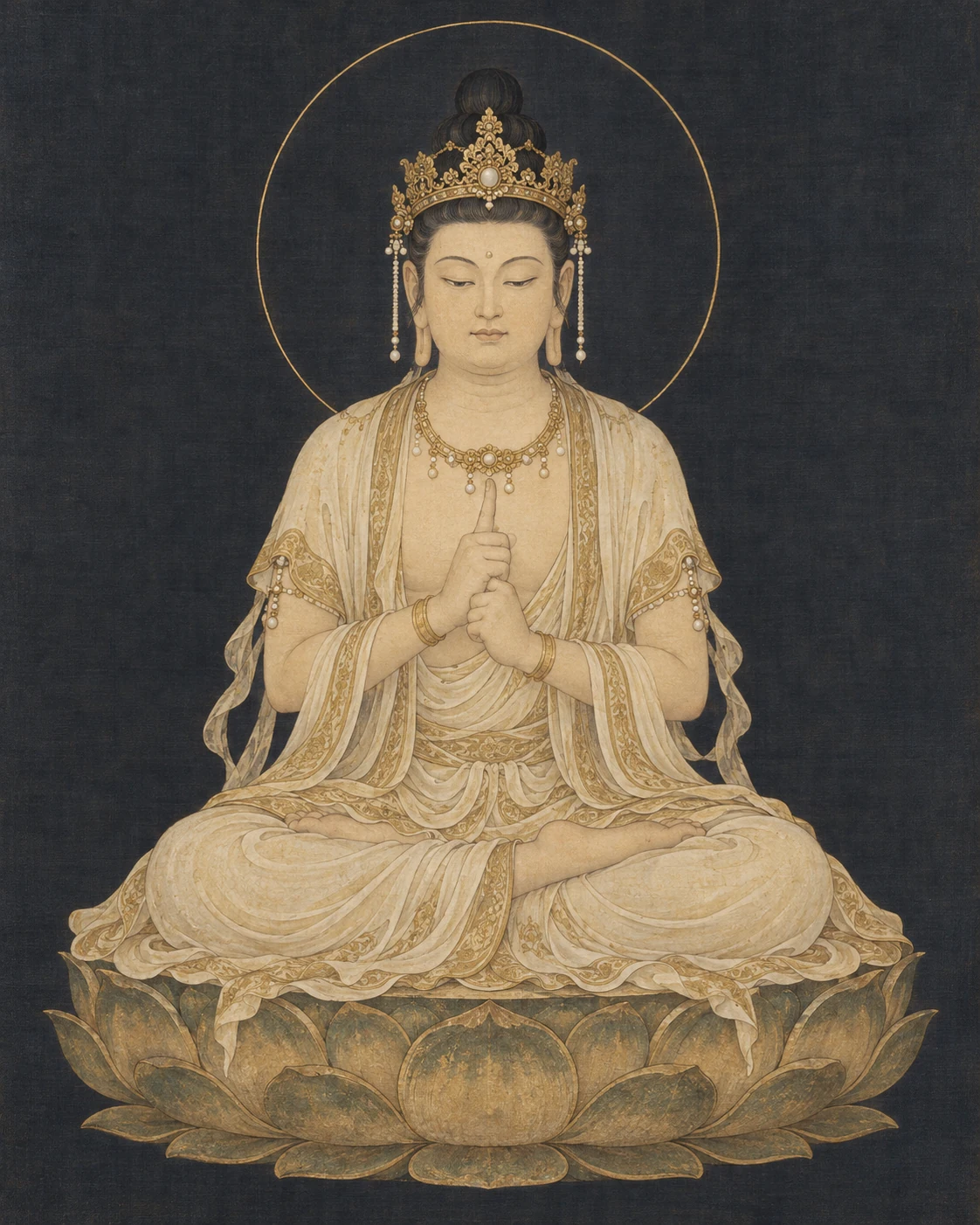
Kongōkai Dainichi Nyorai is the buddha at the center of the esoteric world of wisdom. Tōji explains that the four buddhas Ashuku, Hōshō, Amida, and Fukūjōju are arranged around Dainichi Nyorai, forming the Five Wisdom Buddhas (Gochi Nyorai).
This introduction is based on materials from Shōhōin (Tobi Fudō). It is summarized within the scope of the beliefs and traditions those materials convey, and does not present explanations or practices shared by all schools, temples, and shrines.
English pages are the site’s own translations of its Japanese pages. The sources cited are in Japanese. 日本語で読む
Dainichi Nyorai at the center of the Diamond Realm
Kongōkai Dainichi Nyorai is the buddha at the center of the esoteric world of wisdom. Tōji explains that the four buddhas Ashuku, Hōshō, Amida, and Fukūjōju are arranged around Dainichi Nyorai, forming the Five Wisdom Buddhas (Gochi Nyorai).
Source: 真言宗総本山 東寺
Guiding people through many forms
Tōji teaches that the chiken-in mudra, formed with both hands, represents the enfolding of all things in Dainichi's wisdom. The mandala centered on Dainichi shows the path to awakening through the workings of many different buddhas.
Source: 真言宗総本山 東寺・飛不動尊 正宝院
Giving form to teachings that words alone cannot convey
The Kōbō Daishi Shōrai Mokuroku, introduced by Tōji, records the words of Keika, Kūkai's teacher, that the power of paintings and diagrams is needed to transmit the deepest secrets of esoteric Buddhism. Mandalas and the forms of the various deities have been valued as a way of conveying such teachings visually.
Source: 真言宗総本山 東寺
Mantra (in Japanese, as written in the sources)
おん ばさらだとばん。
Source: 飛不動尊 正宝院
おん あぼきゃ べいろしゃのう まかぼだら まにはんどま じんばら はらばりたや うん
Source: 真言宗豊山派 金剛院
Shown as written in the Japanese sources. This site does not set how or how many times to recite it.
Related shrines and temples
- Tō-ji (Kyōō Gokoku-ji)Kyoto, Kyoto Prefecture
- Jigen-inIzumisano, Osaka Prefecture
- Amanosan Kongō-jiKawachinagano, Osaka Prefecture
- Dainichi-jiKōnan, Kōchi Prefecture
- Enjō-jiNara, Nara Prefecture
- Banna-jiAshikaga, Tochigi Prefecture
- Fumon-inKōya, Ito District, Wakayama Prefecture
- Manpuku-jiTochigi, Tochigi Prefecture
- Shinjō-jiMinami Ward, Saitama, Saitama Prefecture
- Hōshō-inSugito, Kitakatsushika District, Saitama Prefecture
- Kōtoku-inNakano, Tokyo
- Fukushō-jiKita, Tokyo
- Tōzen-jiTsurumi, Yokohama, Kanagawa Prefecture
- Zensan-jiUeda, Nagano Prefecture
- Shōkō-jiOkaya, Nagano Prefecture
- Kyōfuku-jiShiojiri, Nagano Prefecture
- Kōbō-jiIzumi, Osaka Prefecture
- Ichijō-inUnzen, Nagasaki Prefecture
- Seiryū-jiAomori, Aomori Prefecture
Related kami and buddhas
Sources (in Japanese)
- 飛不動尊 正宝院「仏様の世界:金剛界大日如来」(2026-10-14 確認)
- 飛不動尊 正宝院「仏様の世界:目次」(2026-10-14 確認)
- 飛不動尊 正宝院「仏様の世界:十三仏」(2026-10-14 確認)
- 真言宗総本山 東寺「天、菩薩、明王、如来」(2026-10-15 確認)
- 真言宗総本山 東寺「寺宝」(2026-10-15 確認)
- 真言宗豊山派 金剛院「唱えてみよう」(2026-10-15 確認)