
Bodhisattva (Kannon)
Shō Kanzeon Bosatsu (Shō Kannon)
聖観世音菩薩
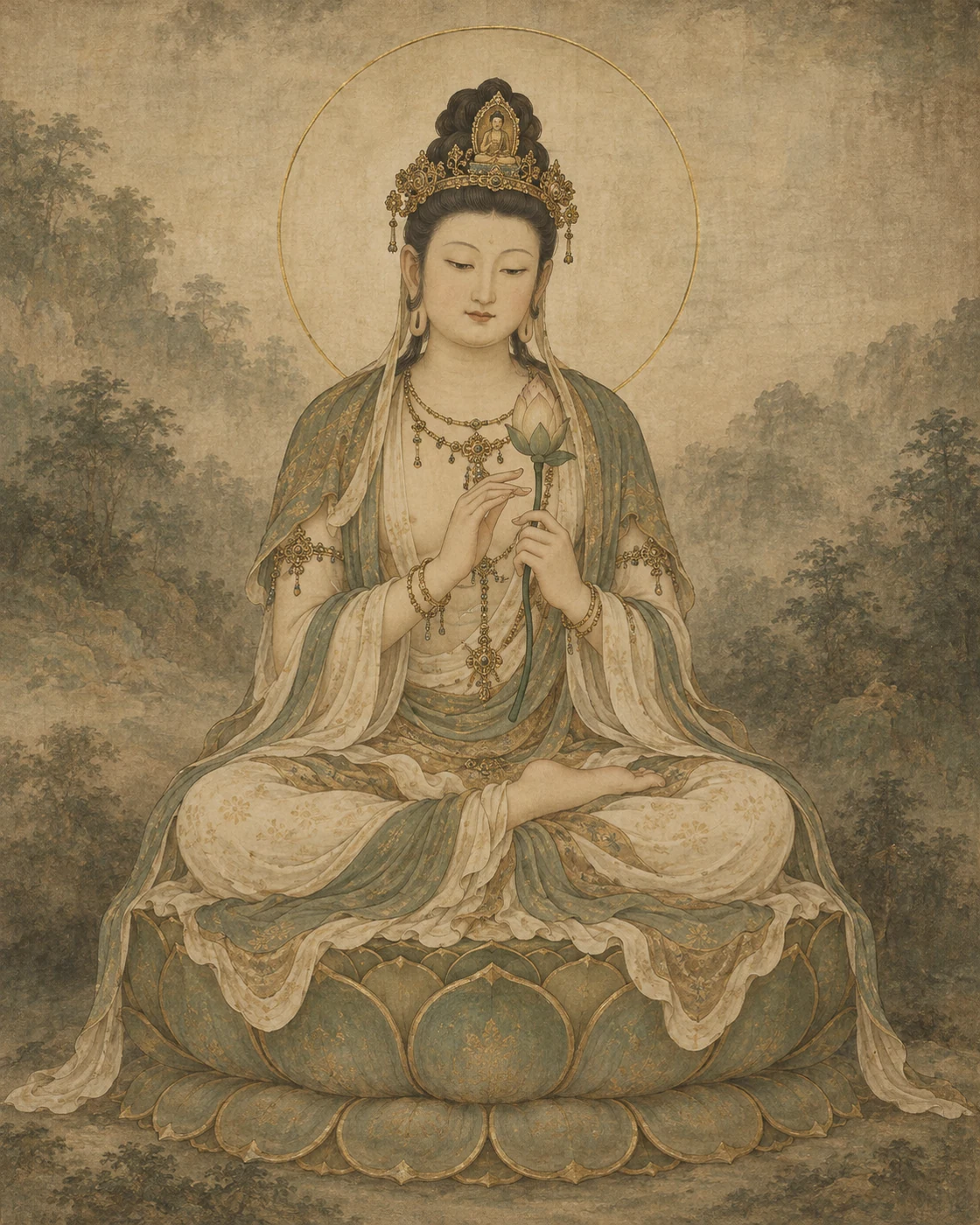
Shō Kanzeon Bosatsu is a bodhisattva of compassion who takes in the voices of suffering people and reaches out a saving hand. Affectionately called "Kannon-sama," this form is regarded as the basic form of Kannon faith, in which Kannon appears in various forms suited to each person.
Faith in Kannon has many forms and traditions. The introduction of Sensōji's principal image and Shōhōin's explanation of the iconography and mantra are presented separately, each based on its own materials.
English pages are the site’s own translations of its Japanese pages. The sources cited are in Japanese. 日本語で読む
Taking in the voices of people's suffering
The name "Kanzeon" expresses the working of perceiving the voices of the people of the world. Sensōji explains the compassion that saves people regardless of their position or where they come from as an important working of its principal image. Kannon is also called "Kanjizai Bosatsu," and Shō Kannon is regarded as the basis of many forms, such as Jūichimen Kannon (Eleven-faced Kannon) and Senju Kannon (Thousand-armed Kannon).
Source: 浅草寺
Faith that prays for rescue from hardship
In Sensōji's explanation of its principal image, the vow of salvation without distinction is placed at the center of faith in Kannon. Rather than a deity limited to one particular wish, Kannon has been cherished as a bodhisattva who faces people carrying all kinds of suffering. The forms of prayer and services at each temple follow that temple's own tradition.
Source: 浅草寺
Kannon who appeared in a fishing net: the origin of Sensōji
Sensōji relates as the beginning of the temple that in 628, the brothers Hinokuma no Hamanari and Takenari, who were fishing in the Sumida River, found a statue of Kannon. According to this founding legend, Hajino Nakatomo recognized its sacred worth and remodeled his own home to enshrine it. This is a local tradition concerning Sensōji's principal image, not the origin of all Kannon statues.
Source: 浅草寺
One face, two arms, and a small buddha in the crown
In Shōhōin's explanation of the iconography, Shō Kannon is introduced as having one face and two arms, with a small image of Amida Nyorai in the crown. This is a clue when comparing it with the transformed forms of Kannon that have many arms and faces. Sensōji's principal image is an absolutely hidden buddha (zettai hibutsu), and the original artwork on this site is not a reproduction of its form.
Source: 飛不動尊 正宝院・浅草寺
The connection with Kongōhō of the Diamond Realm
Shōhōin introduces Kongōhō, one of the Sixteen Great Bodhisattvas of the Diamond Realm (Kongōkai), as a figure also said to be the same as Shō Kannon. Kongōhō belongs to Muryōju Nyorai in the west and is depicted holding a lotus. It is one example of how the relationship can be traced from faith in Shō Kannon to the role in the mandala.
Source: 飛不動尊 正宝院
Mantra (in Japanese, as written in the sources)
おん あろりきゃ そわか
Source: 飛不動尊 正宝院
Shown as written in the Japanese sources. This site does not set how or how many times to recite it.
Related shrines and temples
- Sensō-jiTaitō, Tokyo
- Zenkō-jiNagano, Nagano Prefecture
- Otowa-san Kiyomizu-deraKyoto, Kyoto Prefecture
- Mizuma-deraKaizuka, Osaka Prefecture
- Eihō-jiTajimi, Gifu Prefecture
- Futai-jiNara, Nara Prefecture
- Kannon-inKasukabe, Saitama Prefecture
- Ichinomiya-jiTakamatsu, Kagawa Prefecture
- Kongōrin-jiAishō, Echi District, Shiga Prefecture
- Shōun-ji (Sakai)Sakai Ward, Sakai, Osaka Prefecture
- Kōjō-jiOnomichi, Hiroshima Prefecture
- Tendai-jiNinohe, Iwate Prefecture
- Chōgaku-jiTenri, Nara Prefecture
- Shōsan-jiMinato, Tokyo
- Ryūkō-inKōtō, Tokyo
- Ōfuna Kannon-jiKamakura, Kanagawa Prefecture
- Kiichi-jiMatsuzaki, Kamo District, Shizuoka Prefecture
- Hōshō-jiShinjuku, Tokyo
- Eigen-jiHigashiōmi, Shiga Prefecture
- Chigen-jiMiyazu, Kyoto Prefecture
- Nariai-jiMiyazu, Kyoto Prefecture
- Raikyū-jiTakahashi, Okayama Prefecture
- Tokko-jiShingū, Kasuya District, Fukuoka Prefecture
- Gyokusen-jiTsuruoka, Yamagata Prefecture
- Jakushō-jiTendō, Yamagata Prefecture
- Hōshin-jiKawagoe, Saitama Prefecture
- Renge-inKasukabe, Saitama Prefecture
- Anraku-ji (Yoshimi)Yoshimi, Hiki District, Saitama Prefecture
- Hōshō-jiShinjuku, Tokyo
- Shingyō-jiKōtō, Tokyo
- Rinsen-jiSeki, Gifu Prefecture
- Kaie-jiKariya, Aichi Prefecture
- Ise-jiTakatsuki, Osaka Prefecture
- Chōraku-jiTanba-Sasayama, Hyōgo Prefecture
- Jigen-ji (Nara)Nara, Nara Prefecture
- Sango-jiWakayama, Wakayama Prefecture
- Entsū-jiKurashiki, Okayama Prefecture
- Jigen-ji (Takasaki)Takasaki, Gunma Prefecture
- Shinkan-jiGyōda, Saitama Prefecture
- Rinsen-jiMinato, Tokyo
- Shōdai-jiEdogawa, Tokyo
- Kōsei-jiKamigyō, Kyoto, Kyoto Prefecture
- Jimyō-inHigashi, Hiroshima, Hiroshima Prefecture
Related kami and buddhas
- Sanjūnichi Hibutsu三十日秘仏
- Seishi Bosatsu勢至菩薩
- Amida Nyorai阿弥陀如来
- Semui Bosatsu施無畏菩薩
- Senju Kannon千手観音
- Nyoirin Kannon如意輪観音
- Jūichimen Kannon十一面観音
- Sanjūsan Kannon (the Thirty-Three Kannon)三十三観音
- Roku Kannon, Shichi Kannon and Hachidai Kannon六観音・七観音・八大観音
- Jūsanbutsu (the Thirteen Buddhas)十三仏
- Nijūgo Bosatsu (the Twenty-Five Bodhisattvas)二十五菩薩
- Kongōhō金剛法