
Kannon (bodhisattva)
Nyoirin Kannon
如意輪観音
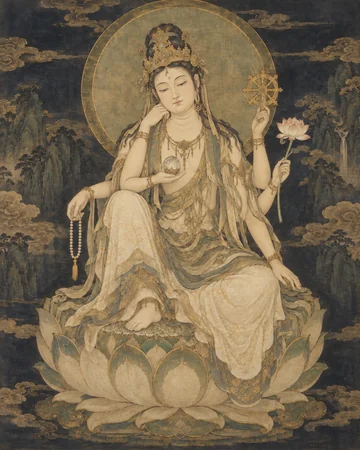
The name of Nyoirin Kannon relates to the nyoi hōju, the jewel that answers wishes, and to the hōrin, the Dharma wheel that represents the Buddha's teaching. It is known for a form that seems to be in contemplation with a hand raised to its cheek, and for a form with six arms. Ishiyama-dera explains that the six arms represent the work of saving people in the six paths.
This introduction is based on materials from Shōhōin (Tobi Fudō). It is summarized within the scope of the beliefs and traditions those materials convey, and does not present explanations or customs common to all schools, shrines, and temples.
English pages are the site’s own translations of its Japanese pages. The sources cited are in Japanese. 日本語で読む
Kannon who saves through the jewel and the Dharma wheel
The name of Nyoirin Kannon relates to the nyoi hōju, the jewel that answers wishes, and to the hōrin, the Dharma wheel that represents the Buddha's teaching. It is known for a form that seems to be in contemplation with a hand raised to its cheek, and for a form with six arms. Ishiyama-dera explains that the six arms represent the work of saving people in the six paths.
Source: 飛不動尊 正宝院・大本山 石山寺
Faith for safe childbirth, good fortune, good relationships and protection from misfortune
At Ishiyama-dera it is worshipped as a Kannon to whom people pray for safe childbirth, good fortune and virtue, good relationships and protection from misfortune. In the Ishiyama pilgrimages of the Heian period, too, wishes connected with the peace of the nation and the prosperity of descendants were offered. It is an example of prayers close to daily life growing within the history of each temple.
Source: 大本山 石山寺
Not only six arms, but also a two-armed form
The principal image of Ishiyama-dera has two arms and sits on a rock with its left leg lowered. The temple explains that this is an older type than six-armed statues. Even for the same Nyoirin Kannon, the number of arms, the way of sitting and the attributes are not uniform.
Source: 大本山 石山寺
Mantra (in Japanese, as written in the sources)
おん はんどま しんだまに じんばら うん。
Source: 飛不動尊 正宝院
オン バラダ ハンドメイ ウン
Source: Wikipedia
Shown as written in the Japanese sources. This site does not set how or how many times to recite it.
Related shrines and temples
- Keishō-jiMatsusaka, Mie Prefecture
- Eifuku-jiTaishi, Osaka Prefecture
- Nyoirin-jiYoshino, Nara Prefecture
- Kanshin-jiKawachinagano, Osaka Prefecture
- Shōbō-jiŌshū, Iwate Prefecture
- Tairyū-jiChūō Ward, Kobe, Hyōgo Prefecture
- Ishiyama-deraŌtsu, Shiga Prefecture
- Gokoku-jiBunkyō, Tokyo
- Oka-deraAsuka, Takaichi District, Nara Prefecture
- Myōon-inTateyama, Chiba Prefecture
- Baishō-inNakano, Tokyo
- Ryūge-inNishi, Kobe
Related kami and buddhas
Sources (in Japanese)
- 飛不動尊 正宝院「仏様の世界:如意輪観音」(2026-10-14 確認)
- 飛不動尊 正宝院「仏様の世界:目次」(2026-10-14 確認)
- 大本山 石山寺「観音の寺」(2026-10-15 確認)
- 大本山 石山寺「ご祈願のご案内」(2026-10-15 確認)
- Wikipedia「如意輪観音(真言の節)」(2026-10-19 確認)