
Kannon (bodhisattva)
Senju Kannon
千手観音
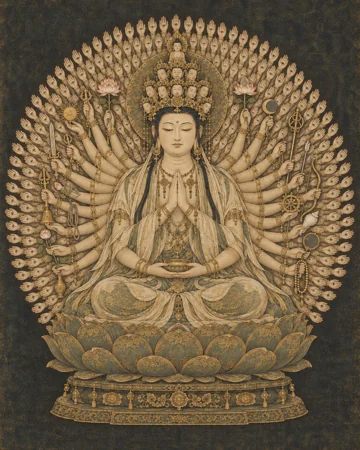
Senju Kannon, also called Senju Sengen Kanzeon Bosatsu, is a Kannon who finds people's suffering with many eyes and seeks to save them with many hands. The number one thousand expresses the breadth of that salvation. Many different ways of helping are also entrusted to the objects held.
This introduction is based on materials from Shōhōin (Tobi Fudō). It is summarized within the scope of the beliefs and traditions those materials convey, and does not present explanations or customs common to all schools, shrines, and temples.
English pages are the site’s own translations of its Japanese pages. The sources cited are in Japanese. 日本語で読む
Broad compassion expressed by a thousand hands and eyes
Senju Kannon, also called Senju Sengen Kanzeon Bosatsu, is a Kannon who finds people's suffering with many eyes and seeks to save them with many hands. The number one thousand expresses the breadth of that salvation. Many different ways of helping are also entrusted to the objects held.
Source: 飛不動尊 正宝院
Expressing a thousand workings with forty-two arms
Besides statues actually made with a great many hands, the forty-two-armed type is well known. The Nara National Museum explains that the forty hands other than the two central ones each save twenty-five worlds. It is a form expressing not only the visible number of arms but a compassion that reaches a wide world.
Source: 奈良国立博物館
Guardians surrounding Kannon and those who pray
The Twenty-eight Attendants are sometimes placed around Senju Kannon. They are said to protect not only Kannon but also the people who have faith in Kannon. Kannon, who saves people, and the guardians who support that teaching are represented as one group.
Source: 奈良国立博物館
Mantra (in Japanese, as written in the sources)
おん ばざらたらま きりく。
Source: 飛不動尊 正宝院
Shown as written in the Japanese sources. This site does not set how or how many times to recite it.
Related shrines and temples
- Otowa-san Kiyomizu-deraKyoto, Kyoto Prefecture
- Dōjō-jiHidakagawa, Wakayama Prefecture
- Kyūan-jiIkeda, Osaka Prefecture
- Kōzan-jiShimonoseki, Yamaguchi Prefecture
- Tosa Kokubun-jiNankoku, Kōchi Prefecture
- Yokei-jiSetouchi, Okayama Prefecture
- Sanuki Kokubun-jiTakamatsu, Kagawa Prefecture
- Nata-deraKomatsu, Ishikawa Prefecture
- Kokawa-deraKinokawa, Wakayama Prefecture
- Rinnō-jiNikkō, Tochigi Prefecture
- Fudō-ji (Matsuida Fudōson)Annaka, Gunma Prefecture
- Matsuo-dera (Yamatokōriyama)Yamatokōriyama, Nara Prefecture
- Shōfuku-jiHigashimurayama, Tokyo
- Ōya-jiUtsunomiya, Tochigi Prefecture
- Jikō-jiTokigawa, Hiki District, Saitama Prefecture
- Taikō-jiIse, Mie Prefecture
- Fukuzen-jiFukuyama, Hiroshima Prefecture
- Shiromine-jiSakaide, Kagawa Prefecture
- Taiyū-jiKita, Osaka
- Nago-jiTateyama, Chiba Prefecture
- Yoshimine-deraNishikyō, Kyoto
- Jiun-jiShimosuwa, Suwa District, Nagano Prefecture
- Sōji-jiIbaraki, Osaka Prefecture
- Shōfuku-jiShirahama, Nishimuro District, Wakayama Prefecture
- Saidai-jiHigashi Ward, Okayama, Okayama Prefecture
- Senkō-jiOnomichi, Hiroshima Prefecture
- Jōei-jiYamaguchi, Yamaguchi Prefecture
- Kichijō-inYamagata, Yamagata Prefecture
- Mizusawa-deraShibukawa, Gunma Prefecture
- Kansei-jiHachiōji, Tokyo
- Manshō-jiEna, Gifu Prefecture
- Jōkō-jiMinami, Kyoto, Kyoto Prefecture
- Senkō-ji (Nishikyō, Kyoto)Nishikyō, Kyoto, Kyoto Prefecture
- Ōzō-jiKakogawa, Hyōgo Prefecture
- Senju-inMatsue, Shimane Prefecture
- Myōjō-inHigashi, Hiroshima, Hiroshima Prefecture
Related kami and buddhas
Sources (in Japanese)
- 飛不動尊 正宝院「仏様の世界:千手観音」(2026-10-14 確認)
- 飛不動尊 正宝院「仏様の世界:目次」(2026-10-14 確認)
- 奈良国立博物館「千手観音二十八部衆像」(2026-10-15 確認)
- 東京国立博物館「千手観音像(国宝・平安時代)」(2026-10-16 確認)