
Wisdom King (myōō)
Gōzanze Myōō
降三世明王
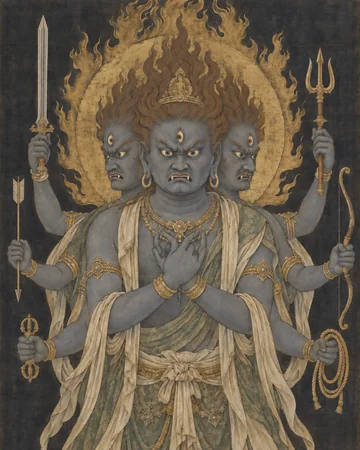
The myōō in charge of the east among the Godaison.
This introduction is based on materials from Shōhōin (Tobi Fudō). It is summarized within the scope of the beliefs and traditions those materials convey, and does not present explanations or customs common to all schools, shrines, and temples.
English pages are the site’s own translations of its Japanese pages. The sources cited are in Japanese. 日本語で読む
The name and role of Gōzanze Myōō
The myōō in charge of the east among the Godaison. The original buddhas are said to be Yakushi Nyorai and Ashuku Nyorai. It is explained that the name Gōzanze comes from the meaning of conquering the enemies of the three realms and the three times, the delusions of greed, anger and ignorance.
Source: 飛不動尊 正宝院・飛不動尊 正宝院・飛不動尊 正宝院
Tracing the form and the traditions
It is introduced in a form with three faces and eight arms.
Source: 飛不動尊 正宝院・飛不動尊 正宝院・飛不動尊 正宝院
The Five Great Myōō, who guide people in stern forms
The Five Great Myōō are a group with Fudō at the center and Gōzanze, Gundari, Daiitoku and Kongō Yasha arranged around him. Tō-ji explains them as the work of Dainichi Nyorai's compassion taking a wrathful form to save people.
Source: 飛不動尊 正宝院・真言宗総本山 東寺
The membership differs by school
Shōhōin notes that in the Tendai tradition, Ususama Myōō is sometimes placed instead of Kongō Yasha. The Five Great Myōō and the Godairiki Bosatsu, who come from a different sutra, also each have their own origins, even though they became connected in later times.
Source: 飛不動尊 正宝院・飛不動尊 正宝院
Mantra (in Japanese, as written in the sources)
おん にそむば ばさらうんぱった。
Source: 飛不動尊 正宝院
オン ソンバ ニソンバ ウン バザラ ウン ハッタ
Source: こんぴら奥の院 箸蔵寺
Shown as written in the Japanese sources. This site does not set how or how many times to recite it.
Related kami and buddhas
Sources (in Japanese)
- 飛不動尊 正宝院「仏様の世界:降三世明王」(2026-10-14 確認)
- 飛不動尊 正宝院「仏様の世界:目次」(2026-10-14 確認)
- 飛不動尊 正宝院「仏様の世界:五大尊」(2026-10-14 確認)
- 真言宗総本山 東寺「天、菩薩、明王、如来」(2026-10-15 確認)
- 飛不動尊 正宝院「仏様の世界:五大力菩薩」(2026-10-14 確認)
- こんぴら奥の院 箸蔵寺「五大明王」(2026-10-19 確認)