
Wisdom King (myōō)
Kujaku Myōō
孔雀明王
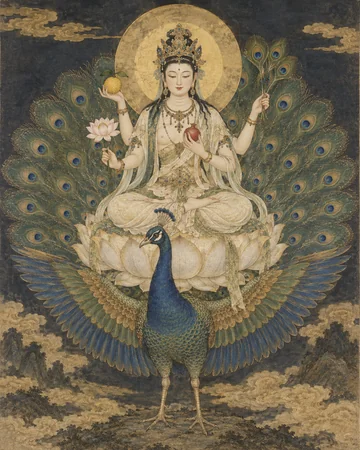
Kujaku Myōō is a deity that deifies the power of the peacock, which was believed to eat venomous snakes. The Nara National Museum explains that Kujaku Myōō was worshipped as a buddha who removes the poisons of the heart, such as attachment and hatred, and protects from misfortune.
This introduction is based on materials from Shōhōin (Tobi Fudō). It is summarized within the scope of the beliefs and traditions those materials convey, and does not present explanations or customs common to all schools, shrines, and temples.
English pages are the site’s own translations of its Japanese pages. The sources cited are in Japanese. 日本語で読む
A myōō expressing the power of the peacock
Kujaku Myōō is a deity that deifies the power of the peacock, which was believed to eat venomous snakes. The Nara National Museum explains that Kujaku Myōō was worshipped as a buddha who removes the poisons of the heart, such as attachment and hatred, and protects from misfortune.
Source: 奈良国立博物館
Prayers to ward off misfortune, and prayers concerning rain
At Shōhōin, Kujaku Myōō is introduced as the principal deity for prayers to remove poison and for prayers to bring rain or to stop rain. The faith in Kujaku Myōō shows the prayers of people who faced both the blessings of nature and natural disasters.
Source: 飛不動尊 正宝院
Not only a gentle face: differences among statues
In Japan, gentle statues with one face and four arms are well known, but among the Chinese examples at the Kyoto National Museum there is also a form with three faces and six arms, whose side faces are stern. The forms of this myōō differ by region and by textual source.
Source: 京都国立博物館
Mantra (in Japanese, as written in the sources)
おん まゆらきらんてい そわか。
Source: 飛不動尊 正宝院
Shown as written in the Japanese sources. This site does not set how or how many times to recite it.
Sources (in Japanese)
- 飛不動尊 正宝院「仏様の世界:孔雀明王」(2026-10-14 確認)
- 飛不動尊 正宝院「仏様の世界:目次」(2026-10-14 確認)
- 奈良国立博物館「いのりの世界のどうぶつえん」(2026-10-15 確認)
- 京都国立博物館「孔雀明王像」(2026-10-15 確認)