
Wisdom King (myōō)
Rokuji Myōō
六字明王
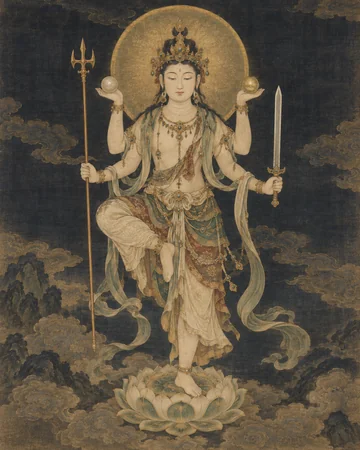
Rokuji Myōō is a deity enshrined as the principal object of worship of the Rokuji-kyō rite, and it is also said to be a transformed form of the Six Kannon. A commentary on cultural properties by Wakayama Prefecture introduces an image with six arms holding sun and moon discs, a sword, a trident and other objects.
This introduction is based on materials from Shōhōin (Tobi Fudō). It is summarized within the scope of the beliefs and traditions those materials convey, and does not present explanations or customs common to all schools, shrines, and temples.
English pages are the site’s own translations of its Japanese pages. The sources cited are in Japanese. 日本語で読む
Rokuji Myōō and its connection with the work of the Six Kannon
Rokuji Myōō is a deity enshrined as the principal object of worship of the Rokuji-kyō rite, and it is also said to be a transformed form of the Six Kannon. A commentary on cultural properties by Wakayama Prefecture introduces an image with six arms holding sun and moon discs, a sword, a trident and other objects.
Source: 和歌山県教育庁文化遺産課
Calming misfortune, and praying for safe childbirth and long life
The Rokuji-kyō rite has a history of calming misfortune and of praying for safe childbirth and long life. The principal object of worship is represented not only by standalone Rokuji images but also in mandalas in which the Six Kannon, Fudō and Daiitoku are arranged. The ways the images were handed down and the lineages of the rite differ.
Source: 和歌山県教育庁文化遺産課・奈良国立博物館
The names Rokujison and Rokujiten
Rokuji Myōō is also called Rokujison and Rokujiten. Rokumei Bunko places it in the "Nyorai" category following a reference iconographic dictionary, but here it can also be found in the conventional "Myōō" list. Classification in a catalog is considered separately from treating every deity with the same image or rite.
Source: 鹿鳴文庫
The four-armed form shown here, and a six-armed example
The form on this page is based on the four-armed (shihi) type introduced by Shōhōin. It raises the right foot and holds a jewel, a sword and a spear. On the other hand, the Rokuji image of Hōju-in explained by Wakayama Prefecture has six arms (roppi): two holding sun and moon discs, two forming mudras, and two holding a sword and a trident. The six-armed example introduced in the text and the four-armed form shown here are different types.
Source: 飛不動尊 正宝院・和歌山県教育庁文化遺産課
Sources (in Japanese)
- 飛不動尊 正宝院「仏様の世界:六字明王」(2026-10-14 確認)
- 飛不動尊 正宝院「仏様の世界:目次」(2026-10-14 確認)
- 和歌山県教育庁文化遺産課「絹本著色六字尊像」(2026-10-15 確認)
- 奈良国立博物館「六字経曼荼羅」(2026-10-15 確認)
- 鹿鳴文庫「仏像図彙:六字尊(六字天)」(2026-10-15 確認)