
Disciple or founding teacher
Ragora
羅喉羅
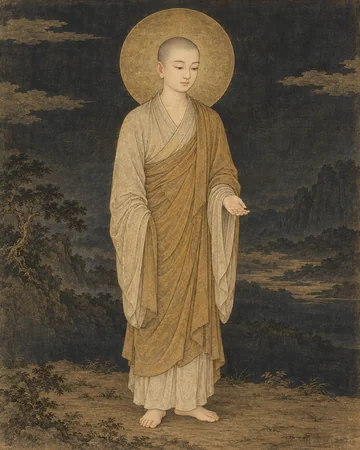
One of the Ten Great Disciples, Shaka's own son, called "foremost in secret practice."
This introduction is based on materials from Shōhōin (Tobi Fudō). It is summarized within the scope of the beliefs and traditions those materials convey, and does not present explanations or customs common to all schools, shrines, and temples.
English pages are the site’s own translations of its Japanese pages. The sources cited are in Japanese. 日本語で読む
The name and role of Ragora
One of the Ten Great Disciples, Shaka's own son, called "foremost in secret practice." Because he was born just before Shaka left home, he is said to have been given a name with meanings such as "hindrance," signifying bondage, and he is described as the only one of the Ten Great Disciples who was also chosen as one of the Sixteen Rakan.
Source: 飛不動尊 正宝院・飛不動尊 正宝院・飛不動尊 正宝院
Tracing the form and traditions
His name is also written 羅怙羅, 羅護羅, 羅雲 and 羅云, all of which are said to be phonetic transcriptions. When Shaka returned home after attaining enlightenment, he left home at the age of 12 as the first boy monk, and it is said that this led to the rule that the permission of both parents is needed for a minor to become a monk.
Source: 飛不動尊 正宝院・飛不動尊 正宝院・飛不動尊 正宝院
People who learned the teaching and passed it on
The Ten Great Disciples are those among Shaka's disciples who are regarded as having excelled in fields such as wisdom, preaching and the precepts. The practice or work in which each excelled is expressed in the title "foremost" (daiichi).
Source: 飛不動尊 正宝院
Until the sutras were handed down
After Shaka's death, the disciples are said to have held a council (ketsujū) to gather and confirm the teachings. A Sōtō school explanation says that Makakashō led the assembly, Ānan recited the teachings, Upari recited the precepts, and the other disciples checked them.
Source: 曹洞宗
Related kami and buddhas
Sources (in Japanese)
- 飛不動尊 正宝院「仏様の世界:羅喉羅」(2026-10-14 確認)
- 飛不動尊 正宝院「仏様の世界:目次」(2026-10-14 確認)
- 飛不動尊 正宝院「仏様の世界:十大弟子」(2026-10-14 確認)
- 曹洞宗「経典」(2026-10-15 確認)
- 鹿鳴文庫「仏像図彙:十大弟子」(2026-10-16 確認)