
Kami (Shinto deity)
Abe no Seimei Kō
安倍晴明公
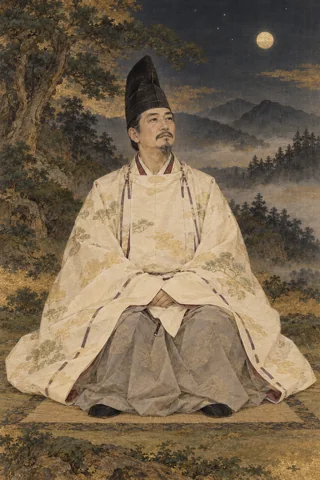
Abe no Seimei (921–1005) was an onmyōji who actually lived in the Heian period. At Seimei Jinja in Kyoto he is enshrined as “Abe no Seimei Kō” and is familiar to people who wish for peace in their daily lives.
This is introduced as faith that enshrines a historical person. You can read about the person's life, later stories, and the faith handed down at Seimei Jinja, each with its own sources.
English pages are the site’s own translations of its Japanese pages. The sources cited are in Japanese. 日本語で読む
What did an onmyōji do?
Onmyōdō developed in Japan on the basis of the ideas of yin-yang and the five phases transmitted from China, along with knowledge of astronomy, calendars, and other fields. The Onmyōryō, a government office, handled calendars, astronomy, divination, and other matters. Onmyōji were also people who judged days, times, and directions, and took part in rites and prayers.
Source: 国立歴史民俗博物館・国立国会図書館
Warding off misfortune and disaster, and wishes for learning and daily life
Seimei Jinja accepts prayer requests for warding off misfortune and disaster, as well as for success in studies and passing exams, physical health, recovery from illness, better fortune at work, fulfillment of heartfelt wishes, and more. It is a faith of praying with a settled heart when carrying the anxieties of life's turning points, or when facing study or work. The benefits listed here describe the wishes brought to the shrine.
Source: 晴明神社
Connections with astronomy and the calendar
The National Diet Library's commentary states that from the Heian period on, the calendar specialty was carried on by the Kamo family, and the astronomy specialty by the Abe family, whose ancestor was Seimei. The work of reading the movements of the sky and the turning of the days is a clue to the history of Onmyōdō.
Source: 国立国会図書館
Stories of shikigami and Dōman
Seimei Jinja hands down a tradition that Seimei hid shikigami under the Ichijō Modoribashi bridge. The kana-zōshi Abe no Seimei Ki, introduced by the National Archives of Japan, tells of a contest with Ashiya Dōman and other episodes. These can be enjoyed as stories that developed richly in later ages, kept apart from the history of the real person.
Source: 晴明神社・国立公文書館
A figure looking up at the stars
The statue of Seimei Kō at Seimei Jinja is based on a portrait in the shrine's collection, and is described as a figure forming a mudra beneath the robe and observing the heavenly bodies in the night sky. The figure on this site is also based on the image of quietly gazing up at the sky.
Source: 晴明神社
The five-pointed star “Seimei Kikyō”
The crest of Seimei Jinja is in the shape of a star with five points and is also called “Seimei Kikyō.” The shrine introduces it as a sign used in Onmyōdō prayers. It can also be seen on the torii and elsewhere in the grounds.
Source: 晴明神社
When visiting for the first time
According to Seimei Jinja's guide to prayer services, after offering a tamagushi, one bows twice, claps twice, and bows once. On this site, you can quietly settle your heart before the figure and turn your thoughts to gratitude and wishes. The “words to recite” below are an example of words used at shrines, and are not a mantra or norito belonging only to Seimei Kō.
Source: 晴明神社・神社本庁
An example of a chant (in Japanese)
祓え給い、清め給え、神(かむ)ながら守り給い、幸(さきわ)え給え
Related shrines and temples
Sources (in Japanese)
- 国立歴史民俗博物館「陰陽師とは何者か — うらない、まじない、こよみをつくる」(2026-10-20 確認)
- 国立国会図書館「日本の暦:暦の渡来と普及」(2026-10-20 確認)
- 晴明神社「御祭神・安倍晴明公」(2026-10-20 確認)
- 晴明神社「御祈祷」(2026-10-20 確認)
- 晴明神社「境内案内:晴明公像・晴明桔梗・旧一條戻橋」(2026-10-20 確認)
- 国立公文書館「ようこそ 歴史資料の宝庫へ:安倍晴明記」(2026-10-20 確認)
- 神社本庁「唱えことば」(2026-10-18 確認)