
Kami of the Kojiki
Iwaoshiwaku no Ko
石押分之子
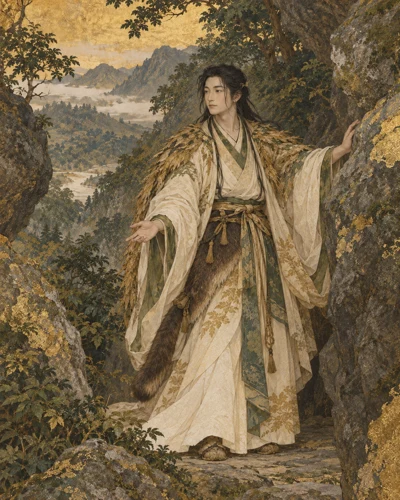
When the army of Emperor Jinmu reached Yoshino, a person with a tail appeared, pushing apart the rocks, named himself Iwaoshiwaku no Ko, a kami of the land, and said that he had come to welcome the child of the heavenly kami. He is recorded as the ancestor of the Kuzu of Yoshino.
This page introduces the name and the story recorded in the Kojiki.
English pages are the site’s own translations of its Japanese pages. The sources cited are in Japanese. 日本語で読む
Story and genealogy in the Kojiki
When the army of Emperor Jinmu reached Yoshino, a person with a tail appeared, pushing apart the rocks, named himself Iwaoshiwaku no Ko, a kami of the land, and said that he had come to welcome the child of the heavenly kami. He is recorded as the ancestor of the Kuzu of Yoshino.
Source: 國學院大學・青空文庫/武田祐吉校訂
Scenes in the text
Appears in the Kojiki in “Yatagarasu Leads the Way” (Record of Emperor Jinmu). You can trace the relevant passages of the text through the sources below.
Source: 國學院大學・青空文庫/武田祐吉校訂
“A person with a tail”: a way of telling in the story
The Kojiki describes Iwaoshiwaku no Ko, who appeared pushing apart the rocks, as “a person with a tail.” There are several interpretations of its meaning, including the view that it shows a figure wearing a seat pad of animal hide. In this illustration it is shown as an animal hide hanging from the waist. This reflects the way the myth tells the story, and is not to be treated as a record describing the actual bodies of the people of Yoshino.
Source: 國學院大學・青空文庫/武田祐吉校訂
An example of a chant (in Japanese)
祓え給い、清め給え、神(かむ)ながら守り給い、幸(さきわ)え給え
Sources (in Japanese)
- 國學院大學「古事記ビューアー・神名データベース「石押分之子」」(2026-10-15 確認)
- 青空文庫/武田祐吉校訂「校註 古事記 〔熊野より大和へ〕」(2026-10-15 確認)