
Kami of the Kojiki
Ōgetsuhime no Kami
大宜都比売神
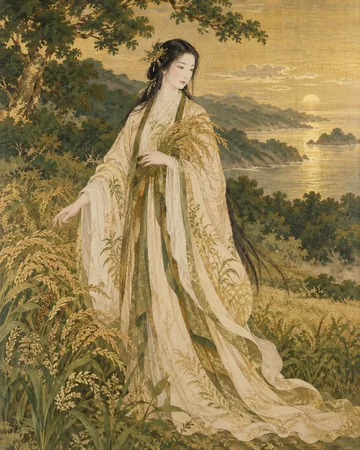
She appears as the name of the land of Awa in the birth of the lands, and as the name of a kami in the birth of the kami. In the scene in which she is killed by Susanoo no Mikoto, who had asked her for food, it is told that silkworms, rice, millet, red beans, wheat and soybeans arose from her body. In the lineage of Ōtoshi no Kami as well, her name is recorded together with Hayamato no Kami as a parent of eight kami. These are not filled in here as one continuous life.
This page introduces the name and the story recorded in the Kojiki.
English pages are the site’s own translations of its Japanese pages. The sources cited are in Japanese. 日本語で読む
Story and genealogy in the Kojiki
She appears as the name of the land of Awa in the birth of the lands, and as the name of a kami in the birth of the kami. In the scene in which she is killed by Susanoo no Mikoto, who had asked her for food, it is told that silkworms, rice, millet, red beans, wheat and soybeans arose from her body. In the lineage of Ōtoshi no Kami as well, her name is recorded together with Hayamato no Kami as a parent of eight kami. These are not filled in here as one continuous life.
Source: 國學院大學・青空文庫/武田祐吉校訂
Names and how they are recorded
Other names are written 大気都比売神 and 大宜津比売神. In the birth of the lands, the name also appears for the land of Awa (粟国, that is, 阿波国).
Source: 國學院大學
Scenes in the text
Appears in the Kojiki in “The Birth of the Land and the Kami” (first volume), “The Banishment of Susanoo no Mikoto” (first volume), and “The Genealogy of Ōtoshi no Kami” (first volume). You can trace the relevant passages of the text through the sources below.
Source: 國學院大學・青空文庫/武田祐吉校訂
An example of a chant (in Japanese)
祓え給い、清め給え、神(かむ)ながら守り給い、幸(さきわ)え給え
Related shrines and temples
Sources (in Japanese)
- 國學院大學「古事記ビューアー・神名データベース「大宜都比売神」」(2026-10-15 確認)
- 青空文庫/武田祐吉校訂「校註 古事記 〔神々の生成〕」(2026-10-15 確認)