
Founder or eminent monk
Kōbō Daishi Kūkai
弘法大師 空海
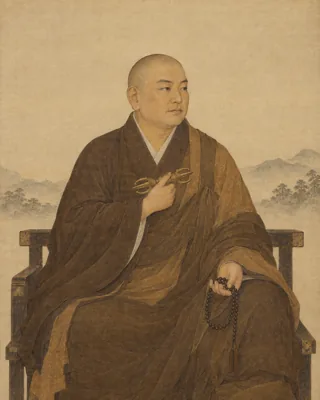
Kūkai was a monk who studied under Keika in Tang China and brought Shingon esoteric Buddhism to Japan. He opened Kōyasan as a base for practice and was later given the posthumous title Kōbō Daishi. In the Shingon school he is still deeply revered as Odaishi-sama.
This page introduces faith in the Daishi as handed down on Mount Kōya, and the life of the historical Kūkai. The gohōgō is a prayer expressing devotion to Kōbō Daishi.
English pages are the site’s own translations of its Japanese pages. The sources cited are in Japanese. 日本語で読む
The one who studied and transmitted esoteric Buddhism
In 804, Kūkai went to Tang China with an envoy mission and studied under Keika at Seiryū-ji in Chang'an. After returning he transmitted Shingon esoteric Buddhism, and in 816 he received permission to found Kōyasan.
Source: 高野山真言宗 総本山金剛峯寺
Odaishi-sama, who walks alongside
In the Daishi faith of Kōyasan, Kōbō Daishi is revered as still present in the Okunoin, wishing for people's happiness. The words “dōgyō ninin” (two traveling together) of the Shikoku pilgrimage express the belief of walking together with the Daishi. On journeys and amid the uncertainties of daily life, the heart that longs for his guidance has been passed down.
Source: 高野山真言宗 総本山金剛峯寺
Learning, opened widely to people
In 828, Kūkai established the Shugei Shuchiin in Kyoto. Kongōbu-ji describes it as a school where ordinary people could also study. Alongside the transmission of religion, his involvement in education and society is also handed down.
Source: 高野山真言宗 総本山金剛峯寺
The legend of the sanko that pointed to Kōyasan
Kongōbu-ji's illustrated record of his life contains a story that a sanko (three-pronged implement) thrown from Tang China came to rest in a pine tree on Kōyasan, showing the place to open his training ground. It can be read as a temple tradition telling of the bond between the Daishi and Kōyasan.
Source: 高野山真言宗 総本山金剛峯寺
Holding a five-pronged vajra and prayer beads
Portraits of Kōbō Daishi have come down in a type in which he sits on a chair, holding a gokosho (five-pronged vajra) in his right hand and prayer beads in his left. The figure on this site is also based on these features.
Source: 香川県立ミュージアム
The founding legend of Hashikura-ji
Hashikura-ji in Tokushima holds that it was founded by Kōbō Daishi after he received a revelation from Konpira Daigongen concerning the salvation of people. The temple's Konpira Daigongen is associated with Kubira Taishō, one of the Twelve Divine Generals of Yakushi. It is one example of the legends of Kōbō Daishi found in various places.
Source: 箸蔵寺
Related shrines and temples
Related kami and buddhas
Sources (in Japanese)
- 高野山真言宗 総本山金剛峯寺「弘法大師の誕生と歴史」(2026-10-15 確認)
- 高野山真言宗 総本山金剛峯寺「日本各地の大師信仰」(2026-10-15 確認)
- 香川県立ミュージアム「弘法大師像(善通寺御影)」(2026-10-15 確認)
- 箸蔵寺「箸蔵寺について:当山縁起・金毘羅大権現とは」(2026-10-16 確認)