
Deva (ten) or guardian deity
Shōmen Kongō
青面金剛
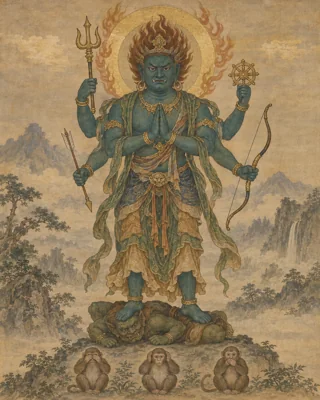
Shōmen Kongō is a deity connected with Kōshin faith. At the Kōshindō of Shitennō-ji he is enshrined as Shōmen Kongō Dōji, and the faith of praying for good health and the fulfillment of wishes is handed down there. He is also depicted in various forms on Kōshin monuments (kōshintō) and elsewhere.
The history of the temple, local stone monuments, and the mantra preserved in written records are introduced source by source. Kōshin faith is also related to Sarutahiko no Ōkami, but the two are not treated as a single name or as customs common throughout Japan.
English pages are the site’s own translations of its Japanese pages. The sources cited are in Japanese. 日本語で読む
A deity enshrined in Kōshin faith
At Shitennō-ji, the principal image of the Kōshindō is called Shōmen Kongō Dōji. The Butsuzō Zui, introduced by Rokumei Bunko, also includes a “Kōshin Shōmen Kongō” and a “Tennōji Kōshin image” in separate places. Even among figures connected with the same Kōshin faith, there are differences depending on the region and the source through which they have come down.
Source: 和宗総本山 四天王寺・鹿鳴文庫
Prayers for good health, and the three monkeys
Shitennō-ji introduces prayers to Shōmen Kongō Dōji for things such as freedom from illness, as well as faith in its hall of the three monkeys (三猿堂). The three monkeys covering their eyes, ears, and mouth take the form of “mizaru, kikazaru, iwazaru”: not seeing, not hearing, not speaking. Here we introduce the faith as handed down by the temple; this does not promise the result of any prayer.
Source: 和宗総本山 四天王寺
The appearance of a youth, as handed down at Shitennō-ji
According to the temple tradition of Shitennō-ji, in Taihō 1 (701), when the priest Gōhan Sōzu prayed for people suffering from an epidemic, a youth appeared as a messenger of Taishakuten. This is introduced as one of the founding legends passed down at the Kōshindō.
Source: 和宗総本山 四天王寺
Six arms, with palms joined
Among the Hundred Kōshin (百庚申) of Muzai in Inzai City there are images with one face and six arms. There is a type with the central hands joined in prayer and a type holding a sword and a human figure, and the illustration on this site is based on the joined-palms type. The remaining four hands hold a trident, a wheel, an arrow, and a bow. Not every image of Shōmen Kongō takes this form.
Source: 印西市
An example of a mantra preserved in the literature
The mantra below is the form that Kubo Noritada's 1956 paper introduces from texts of the “Shōmen Kongō Shinju” (青面金剛神呪). It keeps the forms “kōshinrai” and “maitari.” It does not represent the order of services at Shitennō-ji, nor a mantra specific to Sarutahiko Ōkami.
Source: 東京大学東洋文化研究所/窪徳忠
Mantra (in Japanese, as written in the sources)
オン コウシンライ コウシンライ マイタリ マイタリ ソワカ
Source: 東京大学東洋文化研究所/窪徳忠
おん でいば やきしゃ ばんだ ばんだ かかかか そわか
Source: 高野山真言宗 巌光山 圓満寺
Shown as written in the Japanese sources. This site does not set how or how many times to recite it.
Related shrines and temples
Related kami and buddhas
Sources (in Japanese)
- 鹿鳴文庫「仏像図彙:青面金剛」(2026-10-15 確認)
- 和宗総本山 四天王寺「庚申まいり」(2026-10-15 確認)
- 和宗総本山 四天王寺「庚申堂」(2026-10-15 確認)
- 印西市「ここに注目、武西の百庚申」(2026-10-15 確認)
- 東京大学東洋文化研究所/窪徳忠「日本に傳來した三尸信仰の一側面(1956年)143頁」(2026-10-15 確認)
- 昌福寺「庚申堂・庚申まいりについて」(2026-10-16 確認)
- 高野山真言宗 巌光山 圓満寺「歴史・本尊」(2026-10-19 確認)