
Deity of shinbutsu shūgō (kami–buddha syncretism)
Ugajin
宇賀神
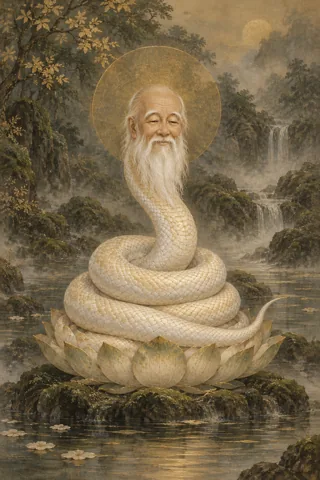
Ugajin is a deity known for the form called jintō jashin, with a human head and a serpent's body. As faith in kami and buddhas became joined in Japan, Ugajin came to be closely connected with Benzaiten and has been familiar to people who pray for wealth and fortune.
This deity is introduced as a deity of shinbutsu shūgō, in which faith in kami and buddhas became joined. The mantra is the form published by Myōenji, which enshrines Ugajin.
English pages are the site’s own translations of its Japanese pages. The sources cited are in Japanese. 日本語で読む
A deity of fortune with a human head and a serpent's body
Kokugakuin University's commentary explains that Ugajin was worshipped as a deity who brings good fortune from around the beginning of the medieval period. Within Tendai doctrine on Mount Hiei, the connection with Benzaiten deepened and developed into faith in Uga Benzaiten.
Source: 國學院大學
Wishing for wealth, money, and fortune in daily life
Mimuroto-ji in Uji, Kyoto, introduces Ugajin as a serpent deity of fortune in wealth and money. A faith has been handed down of stroking the temple's statue and wishing for good luck. Here it is introduced as a faith that turns the heart to the fortune that supports daily life.
Source: 三室戸寺
Points to notice in the figure
The features seen in Mimuroto-ji's guide are an old man's head, a serpent's body, and a figure resting on a lotus. Kokugakuin University's commentary also records an image showing a white serpent with an old man's face above the head of Uga Benzaiten. On this page you can view the human-headed, serpent-bodied figure as a single deity.
Source: 三室戸寺・國學院大學
The connection with Benzaiten
The Kannon Museum of Hase-dera explains that Benzaiten, associated with the arts and eloquence, became linked with Ugajin in Japan and took on a stronger character as a deity of wealth and fortune. At Myōen-ji, Ugajin is enshrined in a cave (iwaya), and Ugajin is also shown above the head of the eight-armed (happi) Uga Benzaiten.
Source: 鎌倉 長谷寺 観音ミュージアム・天台宗 和光山 妙圓寺
How is Ugajin different from Uka no Mitama no Kami?
There is a view that links Ugajin with Uka no Mitama no Kami, who is connected with food and rice. However, there are other views on the origin of the name, and it cannot simply be decided that they are alternative names of the same deity. On this site, the human-headed, serpent-bodied Ugajin and Uka no Mitama no Ōkami, enshrined in the Shimosha of Fushimi Inari Taisha, are introduced on separate pages.
Source: 國學院大學・國學院大學・伏見稲荷大社
The girl who saved crabs, and the folk tale of the serpent-body bridge
A folk tale is handed down at Mimuroto-ji of a girl who saved some crabs and was later rescued from a serpent by those crabs. It is said that the girl dedicated an image of Ugajin to hold a memorial for the serpent. We introduce it as a local story connected with the temple's serpent-body bridge (蛇体橋).
Source: 三室戸寺
Turning the heart to the mantra
Myōen-ji in Hiratsuka, Kanagawa Prefecture, makes public the mantra of Ugajin, the principal deity of its cave. The text below introduces that written form. On the prayer screen, you can turn your heart to the name, the figure, and the mantra.
Source: 天台宗 和光山 妙圓寺
Mantra (in Japanese, as written in the sources)
オン ウガヤ ジャヤギャラベイ ソワカ
Source: 天台宗 和光山 妙圓寺
Shown as written in the Japanese sources. This site does not set how or how many times to recite it.
Related shrines and temples
Related kami and buddhas
Sources (in Japanese)
- 國學院大學「Encyclopedia of Shinto:Ugajin」(2026-10-20 確認)
- 三室戸寺「狛犬ならぬ狛兎と狛蛇」(2026-10-20 確認)
- 天台宗 和光山 妙圓寺「岩屋霊穴 — 宇賀神(岩屋本尊)」(2026-10-20 確認)
- 鎌倉 長谷寺 観音ミュージアム「2025年新春特別開帳 弁天さまと巳年の神仏」(2026-10-20 確認)
- 國學院大學「Encyclopedia of Shinto:Ukanomitama」(2026-10-14 確認)
- 伏見稲荷大社「ご祭神」(2026-10-14 確認)
- 三室戸寺「蛇(巳)に縁のある寺 三室戸寺」(2026-10-20 確認)