
Wisdom King (myōō)
Aizen Myōō
愛染明王
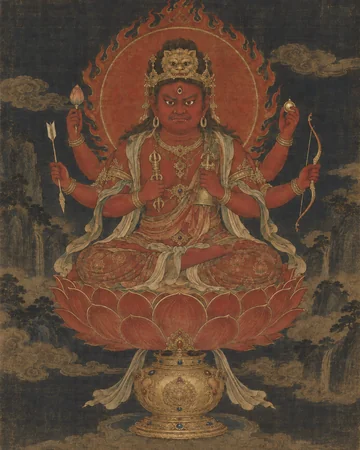
Aizen Myōō is taught to be a deity who leads human desire and worldly passions toward enlightenment. The red body and wrathful expression express the strong workings of the heart around love and affection. Shōhōin introduces a form with six arms.
This introduction is based on materials from Shōhōin (Tobi Fudō). It is summarized within the scope of the beliefs and traditions those materials convey, and does not present explanations or customs common to all schools, shrines, and temples.
English pages are the site’s own translations of its Japanese pages. The sources cited are in Japanese. 日本語で読む
Turning desire into a force toward enlightenment
Aizen Myōō is taught to be a deity who leads human desire and worldly passions toward enlightenment. The red body and wrathful expression express the strong workings of the heart around love and affection. Shōhōin introduces a form with six arms.
Source: 国土交通省 観光庁・飛不動尊 正宝院・国立文化財機構 e国宝
Bonds of fate, and meeting people and things
People bring prayers to Aizen Myōō for success in love and for good connections (en-musubi). A temple description from the Japan Tourism Agency also introduces this as a faith in which people pray for connections with people and things. At Naritasan's Kōmyōdō, too, Aizen Myōō is enshrined as a deity of good connections.
Source: 国土交通省 観光庁・大本山 成田山新勝寺
Three eyes and six arms
The Nara National Museum's description of a statue of Aizen Myōō lists three eyes, six arms and a wrathful expression. In the type introduced by Shōhōin, the six hands hold a five-pronged ritual implement (gokosho), an arrow and a lotus, and a five-pronged bell (gokorei), a bow and a clenched fist. The details of the held objects and the crown differ from type to type.
Source: 国立文化財機構 e国宝・飛不動尊 正宝院
Mantra (in Japanese, as written in the sources)
おん まかあらぎゃ ばさら うしゅにしゃ ばさらさたば じゃうんばんこ。
Source: 飛不動尊 正宝院
ウン タキ ウン ジャク シッジ
Source: Wikipedia
Shown as written in the Japanese sources. This site does not set how or how many times to recite it.
Related shrines and temples
Related kami and buddhas
Sources (in Japanese)
- 飛不動尊 正宝院「仏様の世界:愛染明王」(2026-10-14 確認)
- 飛不動尊 正宝院「仏様の世界:目次」(2026-10-14 確認)
- 国土交通省 観光庁「愛染堂」(2026-10-15 確認)
- 大本山 成田山新勝寺「成田山Q&A」(2026-10-15 確認)
- 国立文化財機構 e国宝「愛染明王坐像(奈良国立博物館・958)」(2026-10-16 確認)
- Wikipedia「愛染明王(真言の節)」(2026-10-19 確認)