
Kami (Shinto deity)
Ame no Minakanushi no Kami
天之御中主神
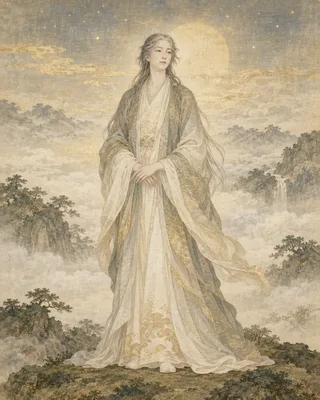
In the Kojiki, Ame no Minakanushi is the first kami to appear in Takamagahara when heaven and earth opened. Together with Takamimusuhi no Kami and Kamumusuhi no Kami, Ame no Minakanushi is called one of the Zōka Sanshin (three kami of creation), and is told to have been a hitorigami (single kami) who hid away.
This page introduces myths and the faith handed down at individual shrines, with their sources. Descriptions of divine virtues are explanations within religious faith and do not guarantee the outcome of any prayer. We do not set uniform rules for the traditions or customs of individual shrines and temples.
English pages are the site’s own translations of its Japanese pages. The sources cited are in Japanese. 日本語で読む
A kami of the beginning of heaven and earth
In the Kojiki, Ame no Minakanushi is the first kami to appear in Takamagahara when heaven and earth opened. Together with Takamimusuhi no Kami and Kamumusuhi no Kami, Ame no Minakanushi is called one of the Zōka Sanshin (three kami of creation), and is told to have been a hitorigami (single kami) who hid away.
Source: 國學院大學
Faith handed down at each shrine
Tōkyō Daijingū enshrines the Zōka Sanshin as kami connected with the work of bringing into being and of joining together (musubi). Suitengū hands down the divine virtues of safe childbirth and the blessing of children for Ame no Minakanushi no Ōkami. We introduce each of these as faith carried on at that shrine.
Source: 東京大神宮・水天宮
A kami with few stories told
Kokugakuin University's explanation points out that Ame no Minakanushi is a kami whose concrete activities are not depicted in the Kojiki. We hold to the account that this kami appears at the beginning of heaven and earth, and do not supply a personality or new stories of miracles.
Source: 國學院大學
An example of a chant (in Japanese)
祓え給い、清め給え、神(かむ)ながら守り給い、幸(さきわ)え給え
Related shrines and temples
Sources (in Japanese)
- 國學院大學「天之御中主神」(2026-10-15 確認)
- 東京大神宮「御由緒・御祭神」(2026-10-15 確認)
- 水天宮「水天宮の御案内」(2026-10-15 確認)
- 國學院大學「古事記ビューアー・神名データベース「天之御中主神」」(2026-10-15 確認)