
Kami (Shinto deity)
Hayaakitsuhime no Kami
速開都比売神
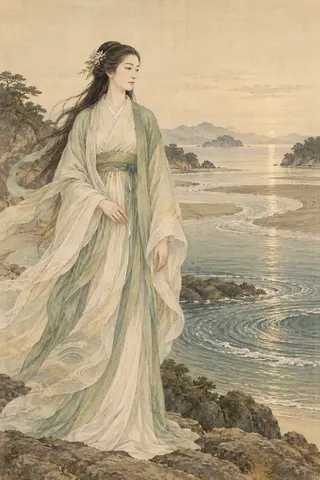
In the Ōharae no Kotoba, Hayaakitsuhime appears as a kami of purification who dwells in the sea where the tides gather. As one of the Haraedo Shishin (four kami of Haraedo), Hayaakitsuhime has the role of receiving what has been carried from the rivers to the sea.
This page introduces the myths told in the classics and the faith handed down in various places, with their sources. It does not guarantee that any particular wish will be fulfilled.
English pages are the site’s own translations of its Japanese pages. The sources cited are in Japanese. 日本語で読む
One of the Haraedo Shishin
In the Ōharae no Kotoba, Hayaakitsuhime appears as a kami of purification who dwells in the sea where the tides gather. As one of the Haraedo Shishin (four kami of Haraedo), Hayaakitsuhime has the role of receiving what has been carried from the rivers to the sea.
Source: 遠江國一宮 小國神社
The work depicted in the Ōharae no Kotoba
Hayaakitsuhime is told of as swallowing the sins and impurities that Seoritsuhime no Kami has carried into the sea, after which the work of Ibukidonushi no Kami follows. There is traditional debate about the relationship with Hayaakitsuhime no Kami (速秋津比売神) of the Kojiki, and in this introduction we do not automatically combine them into a single entry.
Source: 遠江國一宮 小國神社
Faith in purification
Hibiya Jinja enshrines the Haraedo Yohashira no Ōkami (the four great kami of Haraedo) and introduces them as kami who govern purification. The four are also enshrined at the Haraenoyashiro of Izumo Taisha. Here we introduce faith in purification, and do not link illness or suffering with the person's own sins.
Source: 日比谷神社・出雲大社
The Ōharae no Kotoba and the Kojiki
The roles of these four kami are drawn from the Ōharae no Kotoba. The kami born in the purification (misogi) in the Kojiki are not simply called the Haraedo Shishin. We also introduce Hayaakitsuhime no Kami (速秋津比売神), who appears in the birth of the kami in the Kojiki, and Hayaakitsuhime no Kami (速開都比売神) of the Ōharae no Kotoba with their writing and sources kept separate.
Source: 遠江國一宮 小國神社・國學院大學・國學院大學
An example of a chant (in Japanese)
祓え給い、清め給え、神(かむ)ながら守り給い、幸(さきわ)え給え
Related shrines and temples
Related kami and buddhas
Sources (in Japanese)
- 遠江國一宮 小國神社「大祓詞」(2026-10-15 確認)
- 日比谷神社「ご祭神」(2026-10-15 確認)
- 出雲大社「祓社本殿遷座祭」(2026-10-15 確認)
- 國學院大學「『古事記』上巻・神生み(校訂本文)」(2026-10-15 確認)
- 國學院大學「『古事記』上巻・みそぎ②(校訂本文)」(2026-10-15 確認)