
Kami (Shinto deity)
Ninigi no Mikoto
瓊瓊杵尊
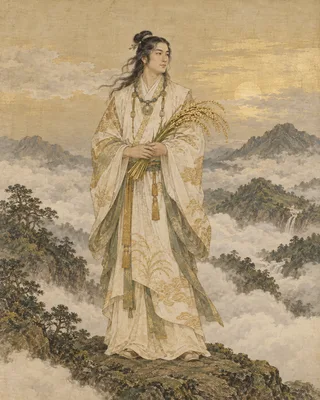
Ninigi no Mikoto is the principal kami of Kirishima Jingū and is introduced as a kami who descended to the earth at the command of Amaterasu Ōmikami. At Kitaguchi Hongū Fuji Sengen Jinja, Ninigi is enshrined together with Konohanasakuyahime no Mikoto as her husband.
This page introduces myths and the faith handed down at individual shrines, with their sources. Descriptions of divine virtues are explanations within religious faith and do not guarantee the outcome of any prayer. We do not set uniform rules for the traditions or customs of individual shrines and temples.
English pages are the site’s own translations of its Japanese pages. The sources cited are in Japanese. 日本語で読む
A kami who is the grandson of Amaterasu Ōmikami
Ninigi no Mikoto is the principal kami of Kirishima Jingū and is introduced as a kami who descended to the earth at the command of Amaterasu Ōmikami. At Kitaguchi Hongū Fuji Sengen Jinja, Ninigi is enshrined together with Konohanasakuyahime no Mikoto as her husband.
Source: 霧島神宮・北口本宮冨士浅間神社
Rice and the life of the land
Kirishima Jingū hands down the tenson kōrin, the descent of the heavenly grandson bearing the three sacred treasures and ears of rice. We introduce Ninigi as a kami connected with rice and the beginnings of the land, and do not newly define here the outcome of particular prayers or benefits common to all regions.
Source: 霧島神宮
The descent of the heavenly grandson to Takachiho
In the tradition told by Kirishima Jingū, Ninigi no Mikoto descends from heaven to Takachihonomine. This introduces the shrine's account of its origins, which connects to the descent of the heavenly grandson in the Kojiki and the Nihon Shoki; it does not unify all the places and interpretations of the myth into one.
Source: 霧島神宮
An example of a chant (in Japanese)
祓え給い、清め給え、神(かむ)ながら守り給い、幸(さきわ)え給え
Related shrines and temples
- Kirishima JingūKirishima, Kagoshima Prefecture
- Fujisan Hongū Sengen TaishaFujinomiya, Shizuoka Prefecture
- Hotaka JinjaAzumino, Nagano Prefecture
- Kitaguchi Hongū Fuji Sengen JinjaFujiyoshida, Yamanashi Prefecture
- Ōhirasan JinjaTochigi, Tochigi Prefecture
- Shinzan JinjaOga, Akita Prefecture
- Karasumori JinjaMinato, Tokyo
- Kosuge JinjaIiyama, Nagano Prefecture
Sources (in Japanese)
- 霧島神宮「御由緒」(2026-10-15 確認)
- 北口本宮冨士浅間神社「御祭神」(2026-10-15 確認)
- 國學院大學「古事記ビューアー・神名データベース「天邇岐志国邇岐志天津日高日子番能邇々芸命」」(2026-10-15 確認)
- 國學院大學「古事記ビューアー・神名データベース「天邇岐志国邇岐志天津日高日子番能邇々芸命」」(2026-10-15 確認)