
Kami (Shinto deity)
Tagitsuhime no Kami
湍津姫神
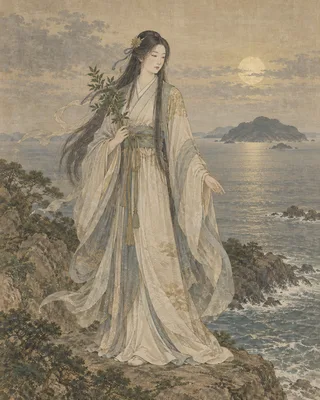
In the present-day guide of Munakata Taisha, Tagitsuhime no Kami is the kami of Nakatsumiya on Ōshima. She is enshrined as one of the three goddesses of Munakata, together with Tagorihime no Kami of Okitsumiya and Ichikishimahime no Kami of Hetsumiya.
This page introduces myths and the faith handed down at individual shrines, with their sources. Descriptions of divine virtues are explanations within religious faith and do not guarantee the outcome of any prayer. We do not set uniform rules for the traditions or customs of individual shrines and temples.
English pages are the site’s own translations of its Japanese pages. The sources cited are in Japanese. 日本語で読む
A goddess enshrined on Ōshima
In the present-day guide of Munakata Taisha, Tagitsuhime no Kami is the kami of Nakatsumiya on Ōshima. She is enshrined as one of the three goddesses of Munakata, together with Tagorihime no Kami of Okitsumiya and Ichikishimahime no Kami of Hetsumiya.
Source: 宗像大社
Faith linking the islands
Through the kami of the three shrines, Munakata Taisha hands down the history of exchange across the sea and of state rites. We introduce Tagitsuhime no Kami as one of these kami, while also noting that there are traditional differences in the names of the three goddesses and in where they are enshrined.
Source: 宗像大社
A name connected with water, and the pledge
Tagitsuhime no Mikoto of the Kojiki is one of the three goddesses born at the pledge between Amaterasu Ōmikami and Susanoo no Mikoto. Kokugakuin University explains the name “Tagi” as relating to swift currents of water, but we keep interpretations of the name's origin distinct from the course of the myth.
Source: 國學院大學
The classics and present-day enshrinement sites
In the Kojiki, Tagitsuhime no Mikoto is said to dwell at Hetsumiya. Present-day Munakata Taisha enshrines Tagitsuhime no Kami at Nakatsumiya. The pairing of names and places differs among sources, and we do not treat the classics and present-day rites as the same account.
Source: 國學院大學・宗像大社
An example of a chant (in Japanese)
祓え給い、清め給え、神(かむ)ながら守り給い、幸(さきわ)え給え
Related shrines and temples
- Munakata TaishaMunakata, Fukuoka Prefecture
- Itsukushima JinjaHatsukaichi, Hiroshima Prefecture
- Kaibara HachimangūTanba, Hyōgo Prefecture
- Kōsō Hachiman JinjaMoji, Kitakyushu, Fukuoka Prefecture
- Enoshima JinjaFujisawa, Kanagawa Prefecture
- Sannomiya JinjaChūō Ward, Kobe, Hyōgo Prefecture
- Asahiyama JinjaNishi Ward, Hiroshima, Hiroshima Prefecture
- Utō JinjaAomori, Aomori Prefecture
- Jūban Inari JinjaMinato, Tokyo
- Achi JinjaKurashiki, Okayama Prefecture
- Tanakayama JinjaAsaminami, Hiroshima
Sources (in Japanese)
- 宗像大社「由緒」(2026-10-15 確認)
- 國學院大學「多岐都比売命」(2026-10-15 確認)
- 國學院大學「『古事記』上巻・うけひ(校訂本文)」(2026-10-15 確認)
- 國學院大學「古事記ビューアー・神名データベース「多岐都比売命」」(2026-10-15 確認)