
Bodhisattva (bosatsu)
Jizō Bosatsu
地蔵菩薩
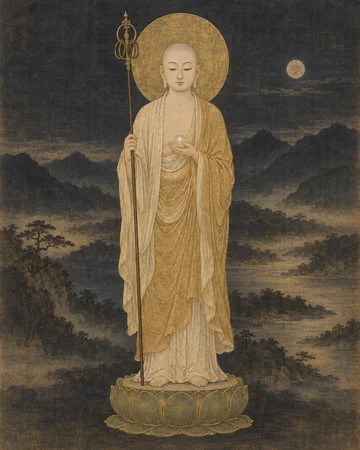
Jizō Bosatsu is worshipped as a bodhisattva who saves people in the period between Shaka's passing into nirvana and the future appearance of Miroku. Jizō stays close to the suffering of the six realms (rokudō), including the hells, and the name expresses a compassion like the great earth that supports all things.
This introduction is based on materials from Shōhōin (Tobi Fudō). It is summarized within the scope of the beliefs and traditions those materials convey, and does not present explanations or practices shared by all schools, temples, and shrines.
English pages are the site’s own translations of its Japanese pages. The sources cited are in Japanese. 日本語で読む
A bodhisattva who goes where salvation is hard to reach
Jizō Bosatsu is worshipped as a bodhisattva who saves people in the period between Shaka's passing into nirvana and the future appearance of Miroku. Jizō stays close to the suffering of the six realms (rokudō), including the hells, and the name expresses a compassion like the great earth that supports all things.
Source: 浄土宗
Protecting children, praying for the departed
In Japan, Jizō has long been a familiar figure, as "Ojizō-sama" who protects children and who stands by roadsides and in cemeteries. Faith in the Six Jizō (Roku Jizō) and in Jizō and the Ten Kings (jūō) also carries the wish for the salvation of those who have died. A wide variety of prayers and founding legends are handed down from region to region.
Source: 浄土宗・浄土宗
A monk's form, with staff and jewel
Jizō is a bodhisattva often depicted in the form of a monk with a shaved head. In Shōhōin's iconography, Jizō holds a monk's staff (shakujō) and a jewel (hōju). This approachable form, unlike the many bodhisattva statues adorned like princes, is a distinctive feature. Among the Thirteen Buddhas (Jūsanbutsu), Jizō is assigned as the guiding figure of the fifth seven-day memorial (itsunanoka).
Source: 飛不動尊 正宝院・浄土宗
The connection with Kongōtō of the Diamond Realm
Shōhōin introduces Kongōtō of the Sixteen Great Bodhisattvas as a figure said to be the same as Jizō Bosatsu. Kongōtō belongs to Hōshō Nyorai in the south and is also called Enman Kongō Bosatsu. Shōhōin's introduction distinguishes it from "Kongōtō Jizō," one of the Six Jizō, by the group each belongs to.
Source: 飛不動尊 正宝院・飛不動尊 正宝院
Mantra (in Japanese, as written in the sources)
おん かかか びさんまえい そわか。
Source: 飛不動尊 正宝院・四国霊場第22番札所 平等寺
かかか そたぬ そわか
Source: 四国霊場第22番札所 平等寺
Shown as written in the Japanese sources. This site does not set how or how many times to recite it.
Related shrines and temples
- Obitoke-deraNara, Nara Prefecture
- Daisen-jiDaisen, Saihaku District, Tottori Prefecture
- Dōsen-jiMimasaka, Okayama Prefecture
- Rokujizō-jiMito, Ibaraki Prefecture
- Kenchō-jiKamakura, Kanagawa Prefecture
- Jūrin-inNara, Nara Prefecture
- Sōfuku-jiGifu, Gifu Prefecture
- Somedono-inNakagyō, Kyoto, Kyoto Prefecture
- Chōden-jiMatsusaka, Mie Prefecture
- Jizō-in (Nishikyō, Kyoto)Nishikyō, Kyoto, Kyoto Prefecture
Related kami and buddhas
Sources (in Japanese)
- 飛不動尊 正宝院「仏様の世界:地蔵菩薩」(2026-10-14 確認)
- 飛不動尊 正宝院「仏様の世界:目次」(2026-10-14 確認)
- 飛不動尊 正宝院「仏様の世界:十三仏」(2026-10-14 確認)
- 浄土宗「新纂浄土宗大辞典:地蔵菩薩」(2026-10-15 確認)
- 浄土宗「新纂浄土宗大辞典:六地蔵」(2026-10-15 確認)
- 飛不動尊 正宝院「仏様の世界:金剛幢」(2026-10-14 確認)
- 飛不動尊 正宝院「仏様の世界:金剛幢地蔵」(2026-10-14 確認)
- 四国霊場第22番札所 平等寺「地蔵菩薩とは:おとなえする真言」(2026-10-15 確認)