
Kami (Shinto deity)
Toyouke no Ōmikami
豊受大御神
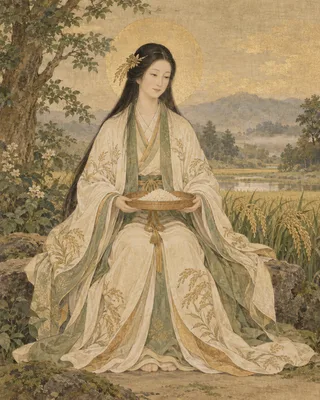
Toyouke no Ōmikami is the kami of the Gekū (Outer Shrine) of Ise Jingū, introduced as Miketsukami, the kami who oversees the meals of Amaterasu Ōmikami. Because of this work of supporting food, Toyouke is revered as a kami connected with daily life and with the work of producing things.
This page introduces myths and the faith handed down at individual shrines, with their sources. Descriptions of divine virtues are explanations within religious faith and do not guarantee the outcome of any prayer. We do not set uniform rules for the traditions or customs of individual shrines and temples.
English pages are the site’s own translations of its Japanese pages. The sources cited are in Japanese. 日本語で読む
The kami of food enshrined at the Gekū
Toyouke no Ōmikami is the kami of the Gekū (Outer Shrine) of Ise Jingū, introduced as Miketsukami, the kami who oversees the meals of Amaterasu Ōmikami. Because of this work of supporting food, Toyouke is revered as a kami connected with daily life and with the work of producing things.
Source: 伊勢神宮
Gratitude for clothing, food, shelter and industry
Ise Jingū describes Toyouke no Ōmikami as the guardian of industries, beginning with clothing, food and shelter. At the Gekū, the Higoto Asayū Ōmike Sai continues, a festival of offering food to the kami every morning and evening that is carefully carried on.
Source: 伊勢神宮
From Tanba to Ise
In the history of Ise Jingū, it is said that Amaterasu Ōmikami appeared in a dream of Emperor Yūryaku and asked that Toyouke no Ōmikami of Tanba be brought to her. This is introduced as the tradition that led to Toyouke being enshrined at the Gekū.
Source: 伊勢神宮
Toyoukebime no Kami and Toyuke no Kami
In the account of the birth of the kami in the first volume, Toyoukebime no Kami is recorded as a child of Wakumusuhi no Kami. In the section on the descent of the heavenly grandson, Toyuke no Kami, who dwells at Watarai of the Gekū, also appears. The relationship between the two is something to be considered together with scholarship and the traditions of Ise, and we do not treat them as a pair stated in the text to be “other names” for each other.
Source: 國學院大學・國學院大學
An example of a chant (in Japanese)
祓え給い、清め給え、神(かむ)ながら守り給い、幸(さきわ)え給え
Related shrines and temples
- Ise Jingū Gekū (Toyouke Daijingū)Ise, Mie Prefecture
- Yokoyama HachimangūMiyako, Iwate Prefecture
- Kono JinjaMiyazu, Kyoto Prefecture
- Ōhirasan JinjaTochigi, Tochigi Prefecture
- Ise JinjaKita Ward, Okayama, Okayama Prefecture
- Kaiseizan DaijingūKōriyama, Fukushima Prefecture
- Shinkotoni JinjaKita, Sapporo, Hokkaido
- Tōkyō DaijingūChiyoda, Tokyo
- Shinkawa DaijingūChūō, Tokyo
- Shiba DaijingūMinato, Tokyo
- Anamori Inari JinjaŌta, Tokyo
- Isehara DaijingūIsehara, Kanagawa Prefecture
- Yamaguchi DaijingūYamaguchi, Yamaguchi Prefecture
- Shinzan JinjaOga, Akita Prefecture
- Ōe JinjaTennōji, Osaka
- Tsuyu no TenjinshaKita, Osaka
Sources (in Japanese)
- 伊勢神宮「豊受大神宮(外宮)の正宮」(2026-10-15 確認)
- 國學院大學「古事記ビューアー・神名データベース「豊宇気毘売神」」(2026-10-15 確認)
- 國學院大學「『古事記』上巻・伊耶那美の神避り(校訂本文)」(2026-10-15 確認)
- 國學院大學「『古事記』上巻・天孫降臨②(校訂本文)」(2026-10-15 確認)
- 國學院大學「古事記ビューアー・神名データベース「豊宇気毘売神」」(2026-10-15 確認)