
Kami (Shinto deity)
Ōmononushi no Ōkami
大物主大神
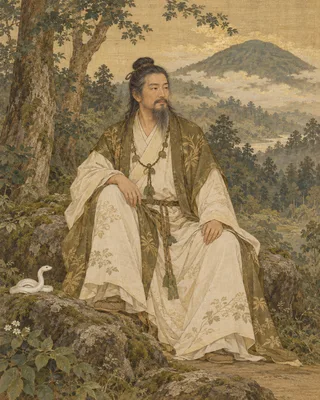
Ōmononushi no Ōkami is the principal kami of Ōmiwa Jinja. The shrine has no main hall and hands down a form of worship in which people pray directly to Mount Miwa. In the shrine's history, Ōmononushi is introduced as the kami who appeared before Ōkuninushi no Kami and asked to be enshrined on Mount Miwa.
This page introduces myths and the faith handed down at individual shrines, with their sources. Descriptions of divine virtues are explanations within religious faith and do not guarantee the outcome of any prayer. We do not set uniform rules for the traditions or customs of individual shrines and temples.
English pages are the site’s own translations of its Japanese pages. The sources cited are in Japanese. 日本語で読む
The kami of Mount Miwa
Ōmononushi no Ōkami is the principal kami of Ōmiwa Jinja. The shrine has no main hall and hands down a form of worship in which people pray directly to Mount Miwa. In the shrine's history, Ōmononushi is introduced as the kami who appeared before Ōkuninushi no Kami and asked to be enshrined on Mount Miwa.
Source: 大神神社
Faith supporting daily life and sake brewing
Ōmiwa Jinja introduces faith connected with building the land and with protecting all aspects of life. A tradition of revering Ōmononushi as a kami of sake brewing is also carried on, based on an old story that fine sake was brewed through the power of the kami.
Source: 大神神社・大神神社
The thread leading to Mount Miwa
In a tale from the Kojiki introduced by Ōmiwa Jinja, a thread is attached to the clothing of a young man who visits Ikutamayorihime, in order to learn who he is. When the thread is followed the next morning, it leads to Mount Miwa, and it becomes clear that the visitor was a kami.
Source: 大神神社
The text and the faith of Miwa
In the first volume, a kami who comes lighting up the sea asks to be enshrined on Mimoro no Yama, but in this scene the kami does not give the name “Ōmononushi no Kami.” The explanation of this kami as Ōmononushi no Kami is based on the traditions and interpretations of Miwa. In the section on Emperor Sujin in the middle volume, the name Ōmononushi no Ōkami is stated clearly, and a rite with Ōtataneko as its chief priest is told.
Source: 國學院大學・青空文庫(武田祐吉注釈校訂)・大神神社
Ōmononushi no Kami enshrined at Kotohiragū
Kotohiragū relates that Ōmononushi no Kami has long been its enshrined kami, and that Emperor Sutoku was later enshrined together with him. On the other hand, Hashikura-ji's identification of Konpira Daigongen with Kubira Taishō is a Buddhist tradition. We introduce the names linked within Konpira faith while keeping each shrine's and temple's explanation separate.
Source: 金刀比羅宮・箸蔵寺
An example of a chant (in Japanese)
祓え給い、清め給え、神(かむ)ながら守り給い、幸(さきわ)え給え
Related shrines and temples
- Ōmiwa JinjaSakurai, Nara Prefecture
- KotohiragūKotohira, Kagawa Prefecture
- Kangō JinjaNara, Nara Prefecture
- Ryūgū JinjaOtaru, Hokkaido
- Kamikawa JinjaAsahikawa, Hokkaido
- Daitōryū JinjaKikugawa, Shizuoka Prefecture
- Gyōda Hachiman JinjaGyōda, Saitama Prefecture
- Miwa JinjaIbigawa, Ibi District, Gifu Prefecture
- Owase JinjaOwase, Mie Prefecture
- Ishiura JinjaKanazawa, Ishikawa Prefecture
Related kami and buddhas
Sources (in Japanese)
- 大神神社「大神神社の御由緒」(2026-10-15 確認)
- 大神神社「三輪山の神語り」(2026-10-15 確認)
- 國學院大學「古事記ビューアー・神名データベース「大物主神」」(2026-10-15 確認)
- 國學院大學「古事記ビューアー・神名データベース「坐御諸山上神」」(2026-10-15 確認)
- 國學院大學「『古事記』上巻・少名毗古那神との国作り(校訂本文)」(2026-10-15 確認)
- 青空文庫(武田祐吉注釈校訂)「『校註 古事記』中巻・崇神天皇「美和の大物主」」(2026-10-15 確認)
- 國學院大學「古事記ビューアー・神名データベース「大物主神」」(2026-10-15 確認)
- 國學院大學「古事記ビューアー・神名データベース「坐御諸山上神」」(2026-10-15 確認)
- 金刀比羅宮「金刀比羅本教教祖 厳魂彦命」(2026-10-16 確認)
- 箸蔵寺「箸蔵寺について:当山縁起・金毘羅大権現とは」(2026-10-16 確認)