
Wisdom King (myōō)
Fudō Myōō
不動明王
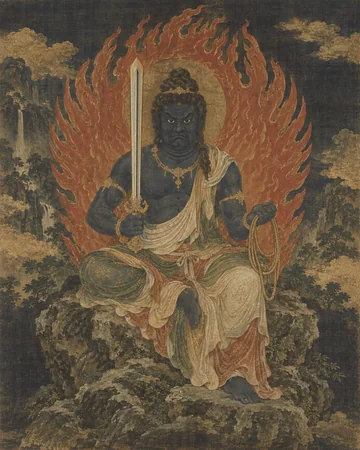
In Shingon esoteric Buddhism, Fudō Myōō is regarded as a manifestation of Dainichi Nyorai. Naritasan Shinshōji teaches that he takes on a wrathful form in order to save people from worldly passions (bonnō). His fearsome expression shows a strong compassion that does not abandon people who are lost.
This introduction is based on materials from Shōhōin (Tobi Fudō). It is summarized within the scope of the beliefs and traditions those materials convey, and does not present explanations or practices shared by all schools, temples, and shrines.
English pages are the site’s own translations of its Japanese pages. The sources cited are in Japanese. 日本語で読む
Unwavering compassion in a stern form
In Shingon esoteric Buddhism, Fudō Myōō is regarded as a manifestation of Dainichi Nyorai. Naritasan Shinshōji teaches that he takes on a wrathful form in order to save people from worldly passions (bonnō). His fearsome expression shows a strong compassion that does not abandon people who are lost.
Source: 大本山 成田山新勝寺
Prayers to remove misfortune and cut through delusion
Shōhōin explains that Fudō Myōō protects those who have faith in him and dwells within their hearts. The teaching that he cuts through delusion and evil thoughts with the sword of wisdom, and restrains bad intentions with his lasso (kensaku) so that good intentions arise, lies behind the faith in which people entrust him with warding off misfortune (yakuyoke) and their heartfelt wishes.
Source: 飛不動尊 正宝院
The meaning of the sword, lasso, flames, and rock
In Naritasan's explanation, the sword represents wisdom, the lasso represents salvation, the flames behind him represent the working that burns away worldly passions, and the rock base (banjaku) represents an unshakable mind. Kongara Dōji and Seitaka Dōji, who stand beside him, are also figures who serve Fudō and assist his work.
Source: 大本山 成田山新勝寺・大本山 成田山新勝寺
Mantra (in Japanese, as written in the sources)
なーまくさーまんだーば さらなんせんだ まーかろしゃーな そわたやうんたらた かんまん。
Source: 飛不動尊 正宝院
のうまく・さんまんだばざらだん・かん
Source: 真言宗 東光院 一灯庵
のうまく・さんまんだ・ばざらだん・せんだ・まかろしゃだ・そわたや・うんたらた・かんまん
Source: 真言宗 東光院 一灯庵
のうまく・さらばたたぎゃていびゃく・さらばぼっけいびゃく・さらばたたらた・せんだまかろしゃだ・けんぎゃきぎゃき・さらばびきんなん・うんたらた・かんまん
Source: 真言宗 東光院 一灯庵
Shown as written in the Japanese sources. This site does not set how or how many times to recite it.
Related shrines and temples
- Naritasan Shinshō-jiNarita, Chiba Prefecture
- Shōgo-inSakyō, Kyoto, Kyoto Prefecture
- Enmei-jiImabari, Ehime Prefecture
- Sayamasan Fudō-jiTokorozawa, Saitama Prefecture
- Nisseki-jiKamiichi, Nakaniikawa District, Toyama Prefecture
- Myōō-inKōya, Ito District, Wakayama Prefecture
- Nan-inKōya, Ito District, Wakayama Prefecture
- Yūshō-jiHonjō, Saitama Prefecture
- Shōden-inHidaka, Saitama Prefecture
- Ryūsen-jiMeguro, Tokyo
- Saimyō-ji (Ōi)Ōi, Ashigarakami District, Kanagawa Prefecture
- Hōjū-jiHigashiyama, Kyoto, Kyoto Prefecture
- Takidani Fudō Myōō-jiTondabayashi, Osaka Prefecture
- Kongō-inKita Ward, Saitama, Saitama Prefecture
- Dōju-inHigashiyama Ward, Kyoto, Kyoto Prefecture
- Saikō-inKawaguchi, Saitama Prefecture
- Sōgan-jiKazo, Saitama Prefecture
- Senzō-inSōka, Saitama Prefecture
- Fumon-ji (Yashio)Yashio, Saitama Prefecture
- Muryōju-inMatsubushi, Kitakatsushika District, Saitama Prefecture
- Ensen-jiSetagaya, Tokyo
- Mitsuzō-inEdogawa, Tokyo
- Kongō-in (Hachiōji)Hachiōji, Tokyo
- An'yō-jiHachiōji, Tokyo
- Keishō-inHigashiyamato, Tokyo
- Daizen-inUrawa, Saitama
- Chōfuku-ji (Hachiōji)Hachiōji, Tokyo
- Kichijōsō-jiGose, Nara Prefecture
Related kami and buddhas
Sources (in Japanese)
- 飛不動尊 正宝院「仏様の世界:不動明王」(2026-10-14 確認)
- 飛不動尊 正宝院「仏様の世界:目次」(2026-10-14 確認)
- 飛不動尊 正宝院「仏様の世界:十三仏」(2026-10-14 確認)
- 大本山 成田山新勝寺「成田山のお不動さまとは」(2026-10-15 確認)
- 大本山 成田山新勝寺「成田山Q&A」(2026-10-15 確認)
- 真言宗 東光院 一灯庵「本尊と教え:不動明王の3つの真言」(2026-10-15 確認)