
Kami (Shinto deity)
Sukunahikona no Mikoto
少彦名命
In the Kojiki, Sukunahikona is said to be a child of Kamumusuhi no Kami and works together with Ōkuninushi no Kami to build the land. Sukunahikona Jinja in Osaka also introduces this connection and reveres Sukunahikona as a kami of medicine, hot springs, sake brewing and more.
This page introduces myths and the faith handed down at individual shrines, with their sources. Descriptions of divine virtues are explanations within religious faith and do not guarantee the outcome of any prayer. We do not set uniform rules for the traditions or customs of individual shrines and temples.
English pages are the site’s own translations of its Japanese pages. The sources cited are in Japanese. 日本語で読む
A small kami who helps build the land
In the Kojiki, Sukunahikona is said to be a child of Kamumusuhi no Kami and works together with Ōkuninushi no Kami to build the land. Sukunahikona Jinja in Osaka also introduces this connection and reveres Sukunahikona as a kami of medicine, hot springs, sake brewing and more.
Source: 國學院大學・少彦名神社
Faith seeking medicine and health
In Dōshōmachi in Osaka, where trade in medicines once flourished, Sukunahikona no Mikoto has been enshrined together with Entei Shinnō. This is the faith of people working with medicine and of people who pray for health, and the origins of the two deities are introduced separately.
Source: 少彦名神社
Arriving from the sea, crossing to Tokoyo
In Kokugakuin University's explanation of the Kojiki, the identity of the kami who appeared from the sea in a small boat becomes known through the advice of Kuebiko. It is told that, after working together with Ōkuninushi no Kami, Sukunahikona crossed over to Tokoyo no Kuni.
Source: 國學院大學
A tiny body, riding a boat of seed pods
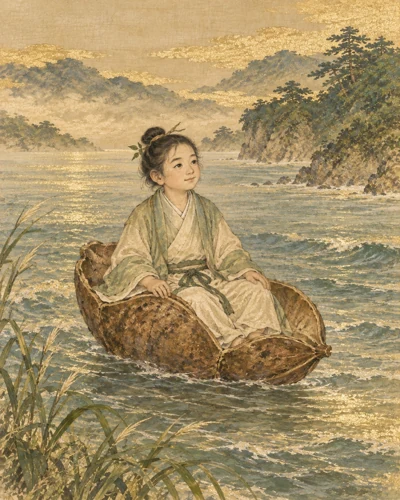
In the Kojiki, Sukunabikona no Kami appears from the sea riding a boat of ame no kagami (羅摩) and builds the land with Ōkuninushi no Kami. In Kokugakuin University's explanation, Sukunabikona is told of as a kami so small as to have slipped through the fingers of Kamumusuhi no Kami. To convey that smallness, this image depicts a beardless, childlike figure. The story does not set a specific age, and the facial features and clothing are the artist's interpretation.
Source: 國學院大學
An example of a chant (in Japanese)
祓え給い、清め給え、神(かむ)ながら守り給い、幸(さきわ)え給え
Related shrines and temples
- Hokkaidō JingūSapporo, Hokkaido
- Taiheizan Miyoshi JinjaAkita, Akita Prefecture
- Kanda MyōjinChiyoda, Tokyo
- Kangō JinjaNara, Nara Prefecture
- Sakatsura Isosaki JinjaHitachinaka, Ibaraki Prefecture
- Ōarai Isosaki JinjaŌarai, Ibaraki Prefecture
- Ōkunitama JinjaIwaki, Fukushima Prefecture
- Shitori JinjaYurihama, Tōhaku District, Tottori Prefecture
- Sasaki JinjaŌmihachiman, Shiga Prefecture
- Tarumi JinjaSuita, Osaka Prefecture
- Kozuchi JinjaŌtsuchi, Kamihei District, Iwate Prefecture
- Yuki JinjaSakyō, Kyoto
- Yukura JinjaHakodate, Hokkaido
- Kamikawa JinjaAsahikawa, Hokkaido
- Onsen JinjaŌsaki, Miyagi Prefecture
- Fukushima TenmangūFukushima, Osaka, Osaka Prefecture
- Sukunahikona JinjaChūō, Osaka, Osaka Prefecture
- Onaga TenmangūHigashi Ward, Hiroshima, Hiroshima Prefecture
- Shinzan JinjaOga, Akita Prefecture
- Torinokosanjō JinjaHitachiōmiya, Ibaraki Prefecture
- Musashi Mitake JinjaŌme, Tokyo
- Kasuga Jinja (Yokosuka)Yokosuka, Kanagawa Prefecture
- Ōe JinjaTennōji, Osaka
- Tsuyu no TenjinshaKita, Osaka
- Hinomine JinjaKomatsushima, Tokushima Prefecture
- Obama JinjaUnzen, Nagasaki Prefecture
- Terushima JinjaIchikikushikino, Kagoshima Prefecture
- Tōsen JinjaKita, Kobe, Hyōgo Prefecture
Sources (in Japanese)
- 國學院大學「少名毘古那神」(2026-10-15 確認)
- 少彦名神社「少彦名神社について」(2026-10-15 確認)
- 國學院大學「古事記ビューアー・神名データベース「少名毘古那神」」(2026-10-15 確認)